Vancouver, B.C., March 6, 2023: SNOWLINE GOLD CORP. (CSE: SGD) (OTCQB: SNWGF) (the “Company” or “Snowline”) is pleased to announce the appointment of Thomas Branson, M.Sc., P.Geo., to the role of Vice President of Exploration. Mr. Branson served as Snowline’s Exploration Manager in 2022, playing a key role on Snowline’s team during a transformative year for the Company that included initial delineation of the large, near-surface, and unusually high-grade bulk tonnage Valley gold discovery on Snowline’s Rogue Project in Canada’s Yukon Territory.
Prior to joining Snowline, Mr. Branson spent 15 years as an exploration geologist, gaining extensive experience in the Yukon and British Columbia, from greenfields exploration through to feasibility studies. He has been involved with organization and management of over 190,000 cumulative metres of exploration and resource drilling on programs in the Wernecke Mountains and Wolverine mine in Yukon, Mount Milligan, Kemess and Scottie Gold mines in BC and elsewhere. His role with Snowline bridges operational and technical aspects of exploration, discovery, team building and project advancement. Mr. Branson earned a B.Sc. in Earth and Ocean Science from the University of British Columbia and an M.Sc. in Exploration Geology from Rhodes University in South Africa. He is a licensed Professional Geologist with Engineers and Geoscientists British Columbia.
“I am excited at the potential for our growing team to continue making game-changing discoveries as we evaluate and explore our land package, roughly equal in size to one quarter of BC’s Golden Triangle, selectively acquired,” said Mr. Branson, referring to the Company’s >280,000 ha land position in the Yukon. “The many prospective targets within Snowline’s Selwyn Basin project areas point to an emerging gold district. Valley and Jupiter appear to be the tip of the iceberg, and with two years now under our belt, we are poised to take advantage of a unique opportunity in the exploration space.”
Other recent internal appointments include Sergio Gamonal to Chief Geologist, Steve Rennalls to Director of Operations, and Stephanie Hansen to Director of Marketing and IR.
“Snowline’s rapid growth trajectory over the past year is as much a testament to the strength of our team as it is to the quality of our exploration targets,” added Scott Berdahl, CEO & Director of Snowline. “We are fortunate to have Thomas Branson, with his broad skillset and exploration mindset, as a key player helping to drive Snowline’s advancement. We are similarly fortunate at the talent that Snowline’s discoveries have attracted, as we continue to build out our team and ramp up our efforts towards making additional discoveries.”
ABOUT SNOWLINE GOLD CORP.
Snowline Gold Corp. is a Yukon Territory focused gold exploration company with a seventeen-project portfolio covering >280,000 ha. The Company is exploring its flagship >137,000 ha Rogue and Einarson gold projects in the highly prospective yet underexplored Selwyn Basin. Snowline’s project portfolio sits within the prolific Tintina Gold Province, host to multiple million-ounce-plus gold mines and deposits including Kinross’ Fort Knox mine, Newmont’s Coffee deposit, and Victoria Gold’s Eagle Mine. The Company’s first-mover land position and extensive database provide a unique opportunity for investors to be part of multiple discoveries and the creation of a new gold district.
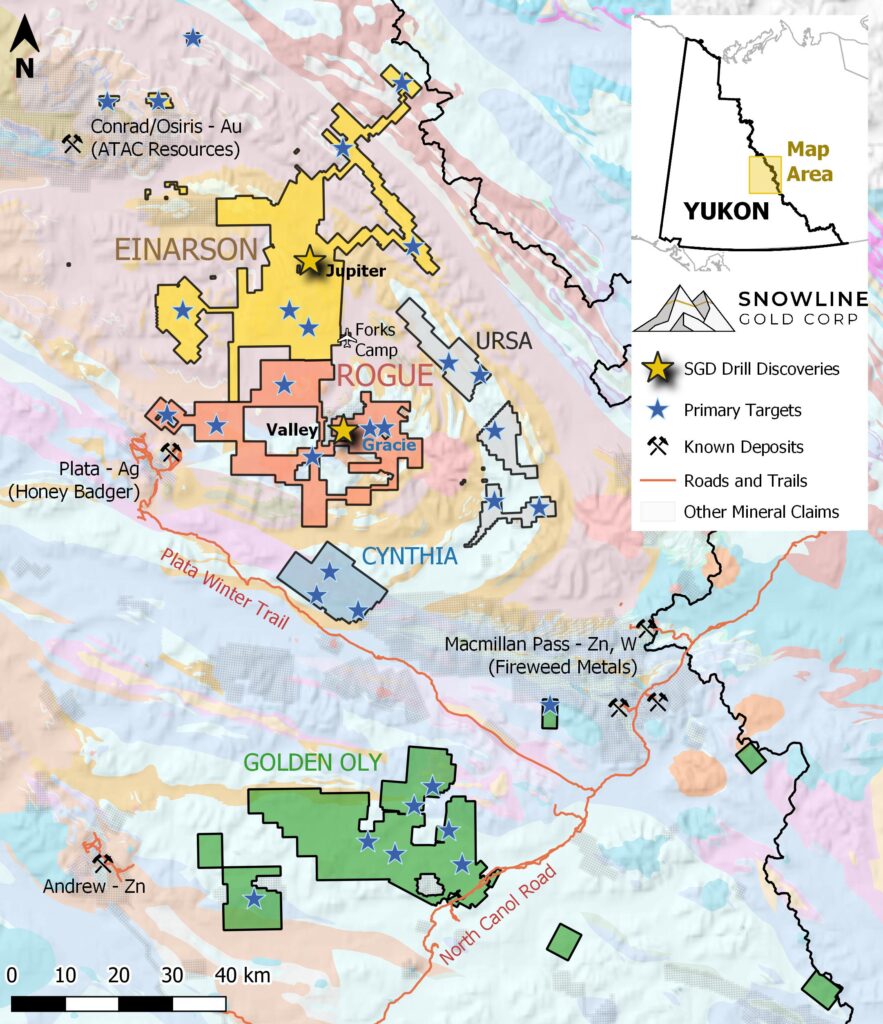
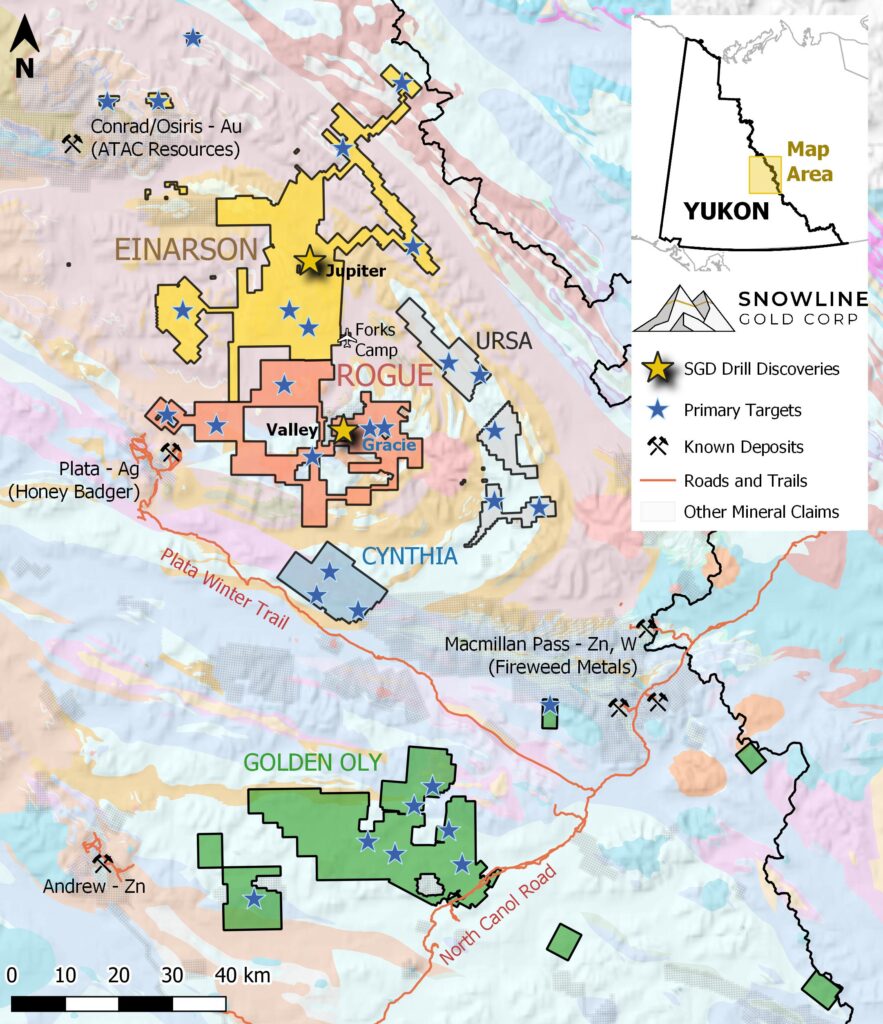
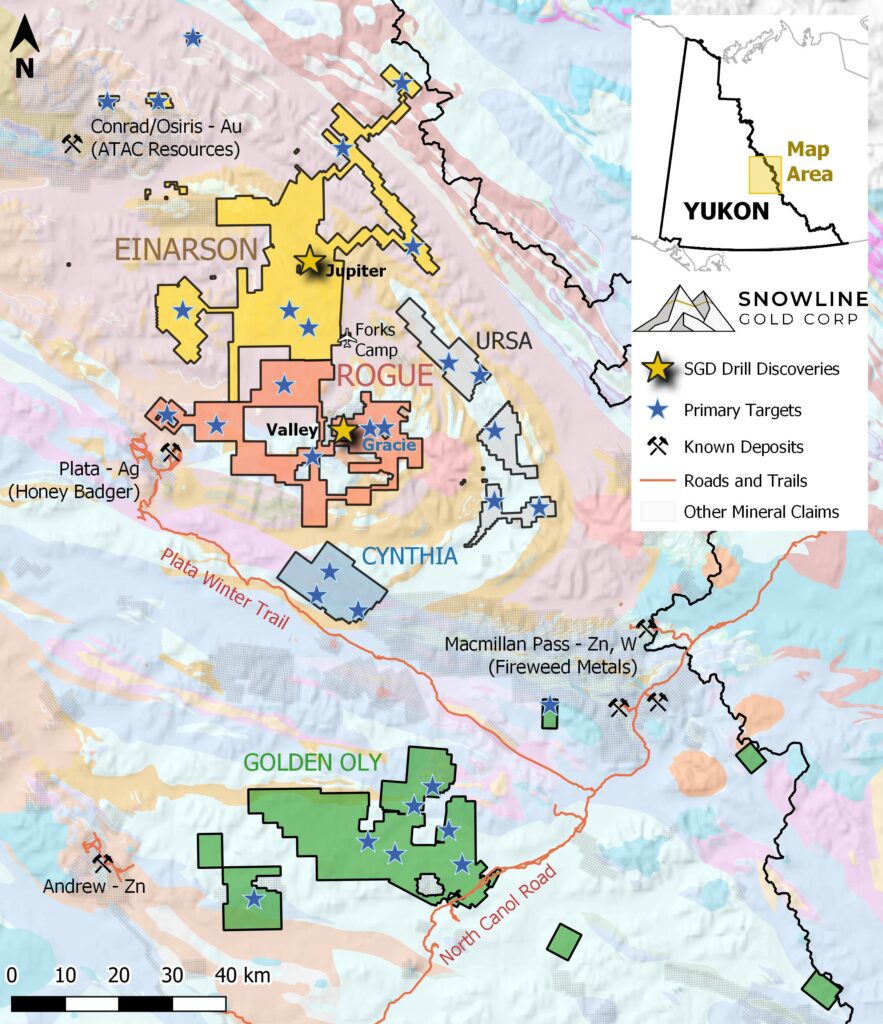
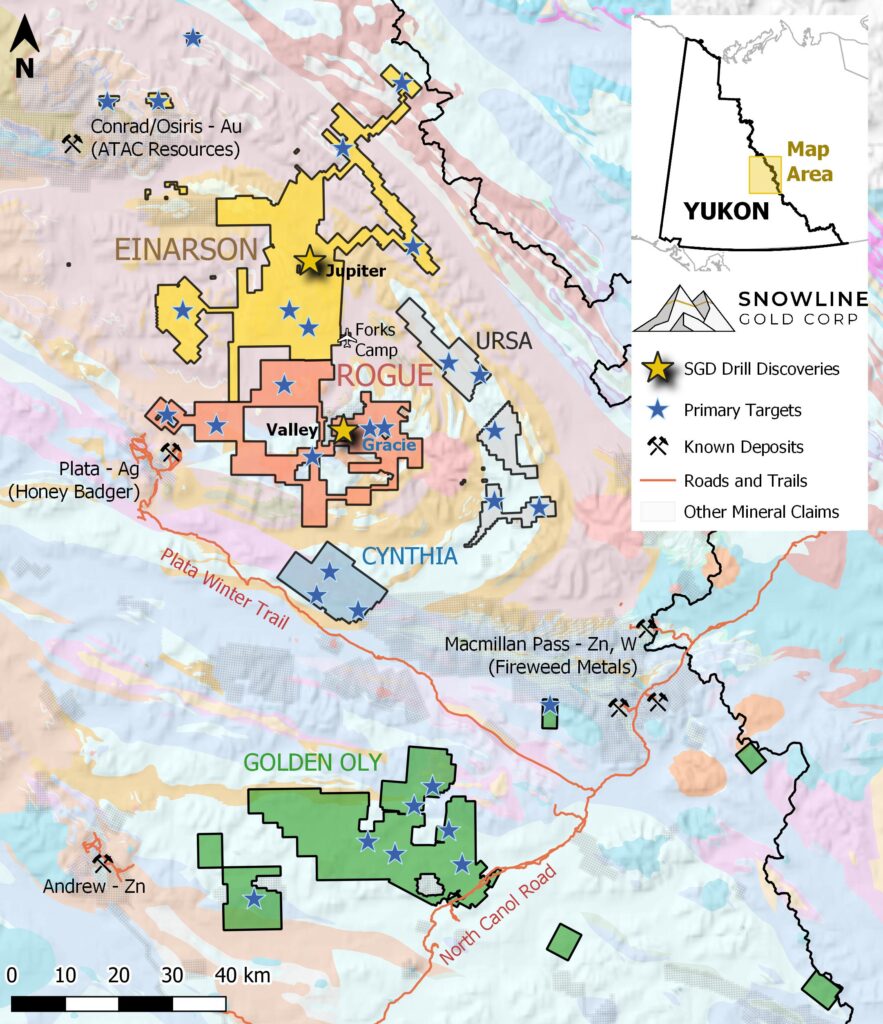
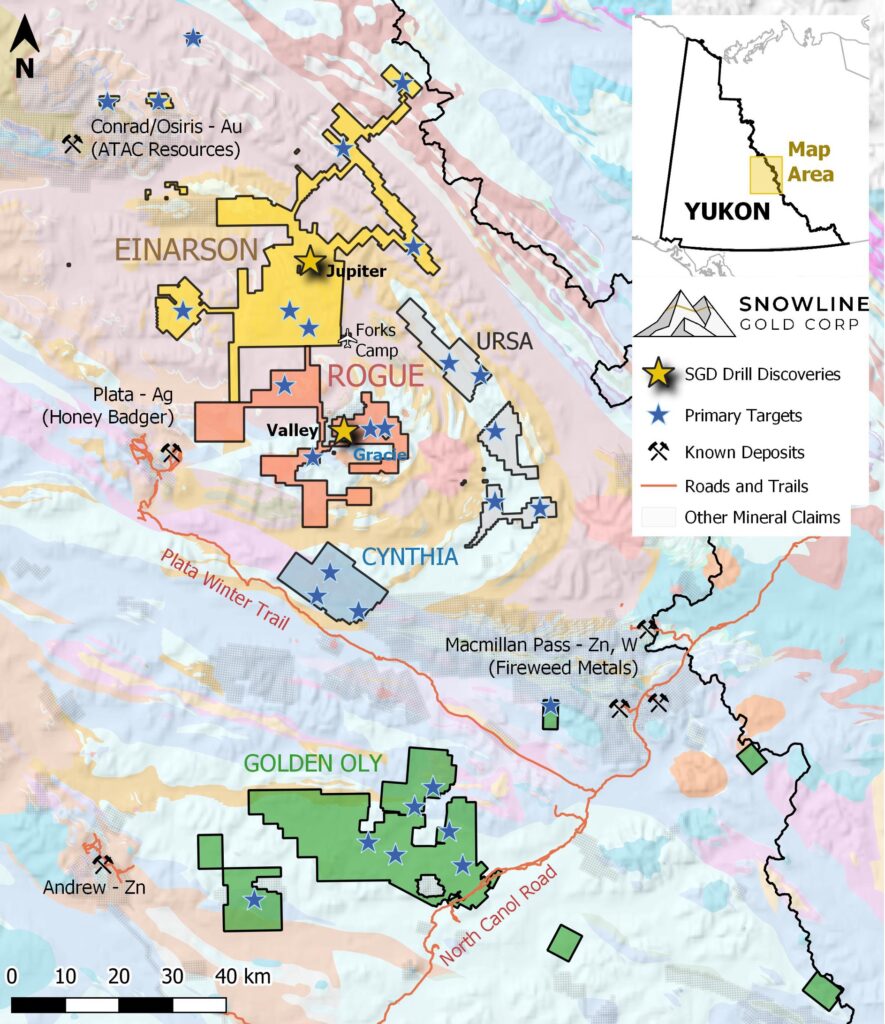
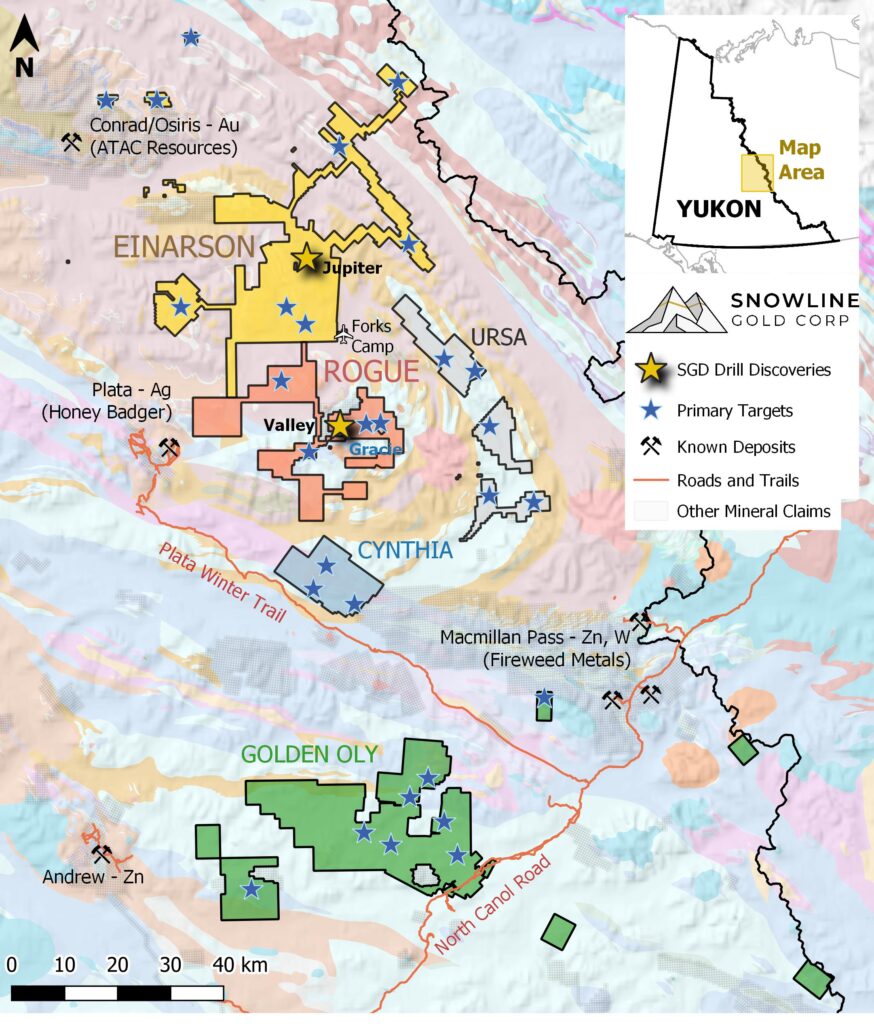
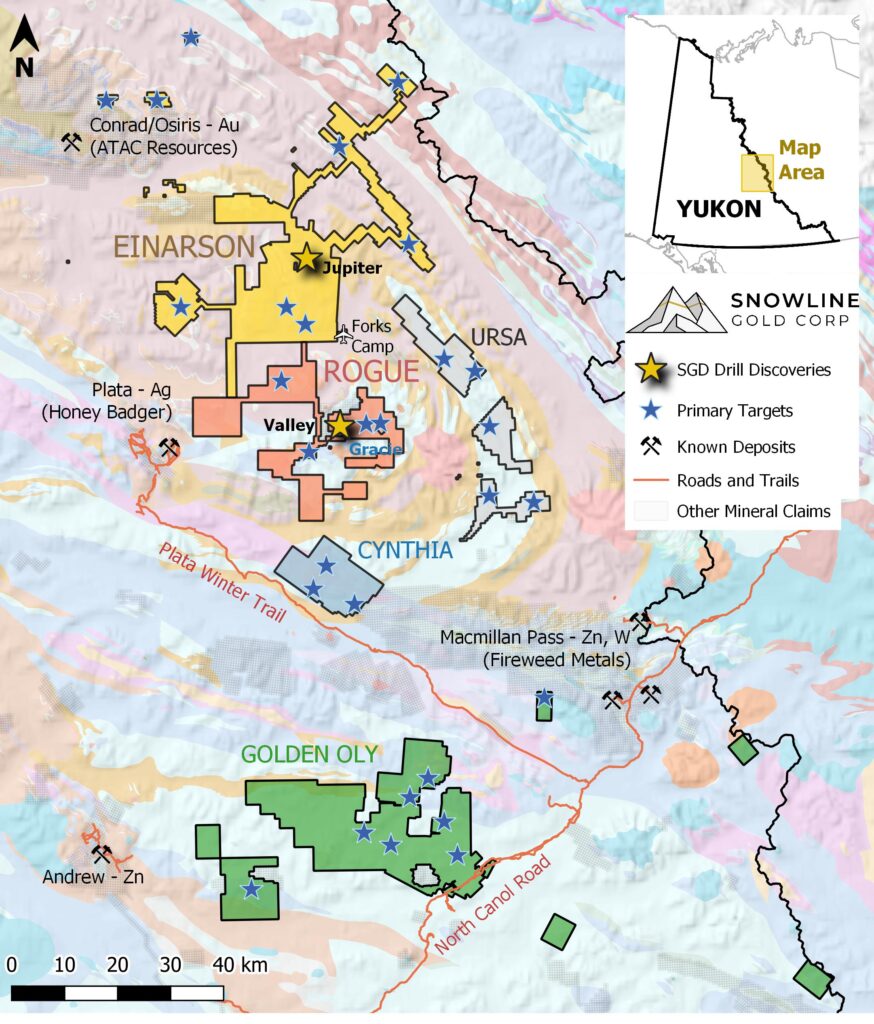
Figure 1 – Project location map for Snowline Gold’s eastern Selwyn Basin properties. The Valley and Gracie Zones on the Rogue are the sites of Snowline’s 2022 drill programs.
QUALIFIED PERSON
Information in this release has been prepared under supervision of and approved by Thomas K. Branson, M.Sc., P. Geo., Vice President of Exploration for Snowline and a Qualified Person for the purposes of National Instrument 43-101.
This news release contains certain forward-looking statements, including statements about the Company’s drill program, results, implied significance of visual inspection of drill core, and surface work and plans for exploring and expanding a new greenfield, district-scale gold system. Wherever possible, words such as “may”, “will”, “should”, “could”, “expect”, “plan”, “intend”, “anticipate”, “believe”, “estimate”, “predict” or “potential” or the negative or other variations of these words, or similar words or phrases, have been used to identify these forward-looking statements. These statements reflect management’s current beliefs and are based on information currently available to management as at the date hereof.
Forward-looking statements involve significant risk, uncertainties and assumptions. Many factors could cause actual results, performance or achievements to differ materially from the results discussed or implied in the forward-looking statements. Such factors include, among other things: risks related to uncertainties inherent in drill results and the estimation of mineral resources; and risks associated with executing the Company’s plans and intentions. These factors should be considered carefully, and readers should not place undue reliance on the forward-looking statements. Although the forward-looking statements contained in this news release are based upon what management believes to be reasonable assumptions, the Company cannot assure readers that actual results will be consistent with these forward-looking statements. These forward-looking statements are made as of the date of this news release, and the Company assumes no obligation to update or revise them to reflect new events or circumstances, except as required by law.
Hole V-22-029 returned 1.26 g/t Au over 558.7 m from surface, including 2.04 g/t Au over 202.0 m in 207 m step-back from previous highlight hole V-22-010
Longest mineralized intersection to date at Valley, expands width of central high-grade zone significantly to the north and demonstrates strong continuity to depth
Assays still pending for 3 holes drilled at Rogue in 2022, along with surface results from various targets and properties in Snowline’s portfolio.
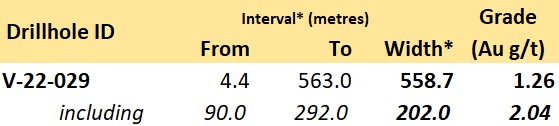
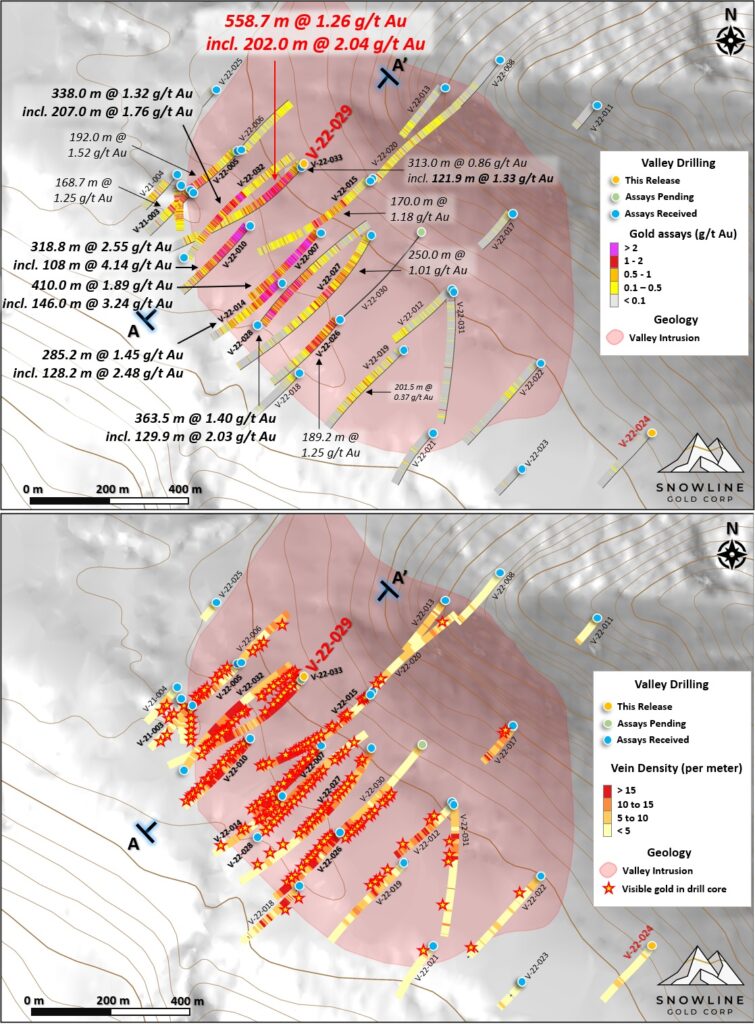
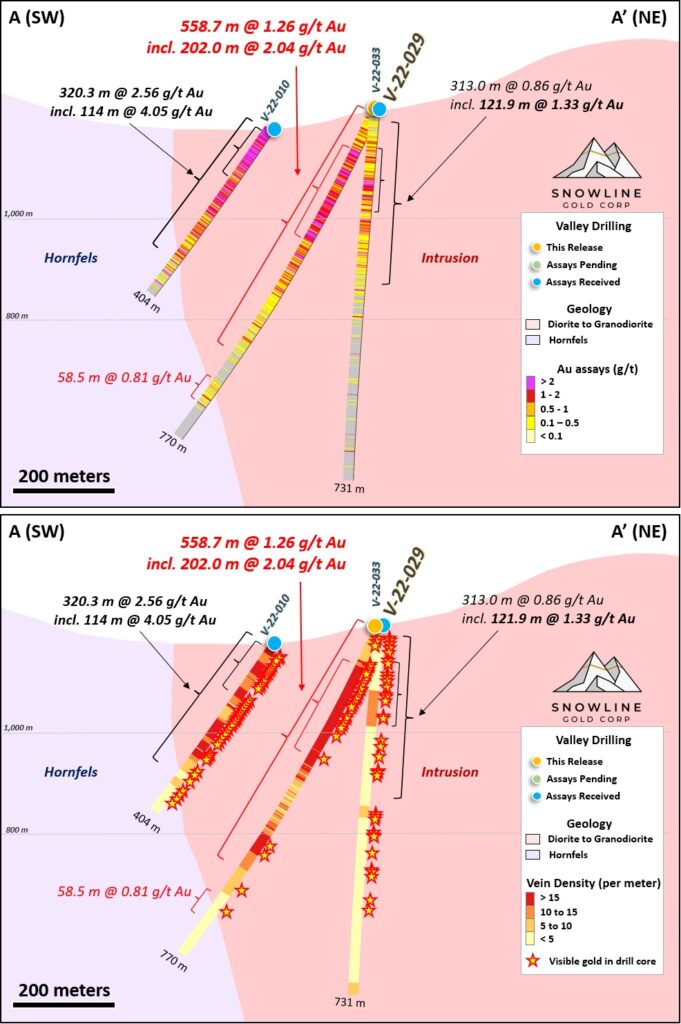
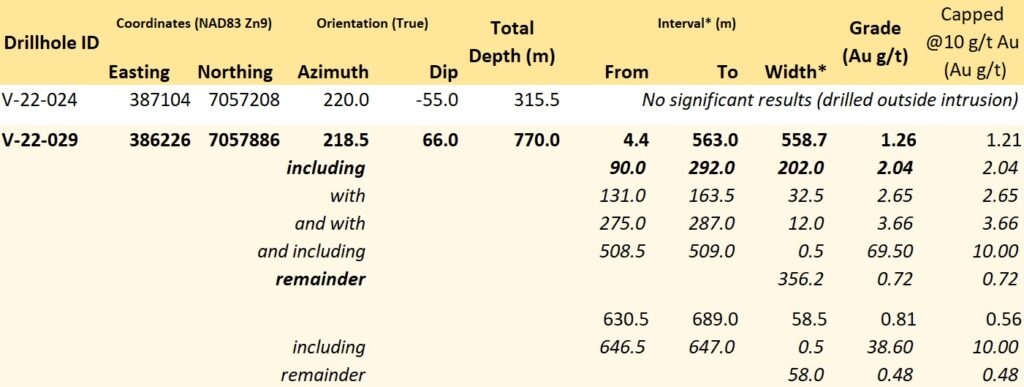
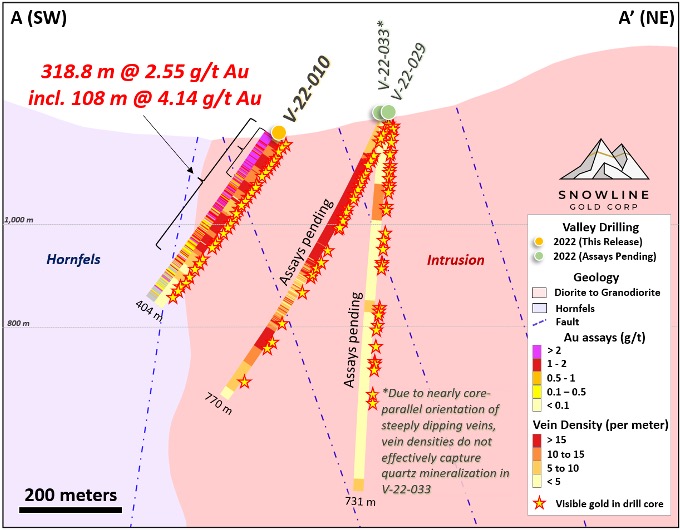
Vancouver, B.C., February 24, 2023: SNOWLINE GOLD CORP. (CSE: SGD) (US OTCQB: SNWGF) (the “Company” or “Snowline”) is pleased to announce additional preliminary assay results from its 2022 drilling programs at its Rogue Project in Canada’s Yukon Territory. Hole V-22-029 intersected sheeted quartz vein mineralization within the Valley intrusion averaging 1.26 g/t Au over 558.7 m from surface, including 2.04 g/t Au over 202.0 m, with additional mineralization at depth (Tables 1 and 2). The hole was collared at a 207 m step-back perpendicular to strike from V-22-010 (318.8 m @ 2.55 g/t Au from surface) to test the local width of Valley’s near-surface, well mineralized corridor and the continuity of mineralization to depth.
Table 1 – Preliminary highlight summary of Snowline’s latest assay results. *Interval widths reported; true widths of the system are not yet known.
“V-22-029 exceeded our expectations, intersecting strong mineralization much higher in the hole than we originally anticipated and continuing to significant depth,” said Scott Berdahl, CEO & Director of Snowline. “It’s the longest continuously mineralized interval we’ve drilled at Valley to date, and like many of Valley’s best holes the interval begins at bedrock surface. For perspective, I invite anybody visiting Toronto for PDAC to look at the CN Tower, which stands 553.3 m tall, just shy of the length of this mineralized interval. The scale, grade and continuity of the gold system at Valley continue to impress us, and we look forward to additional results.”
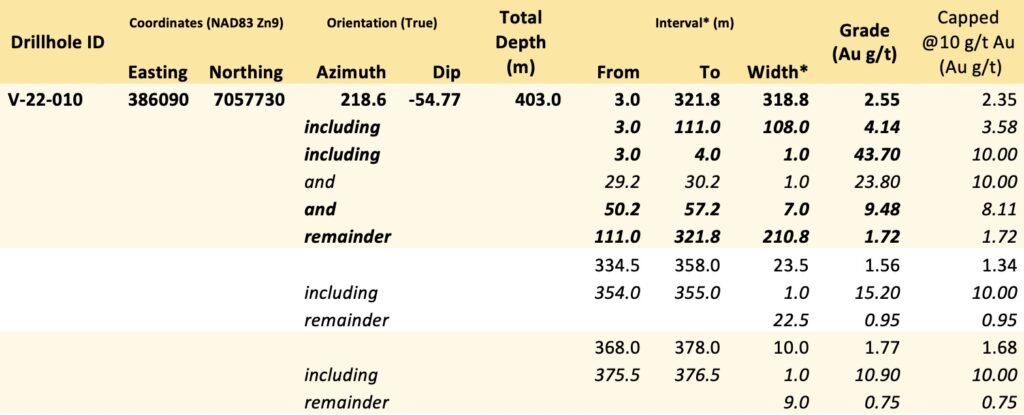
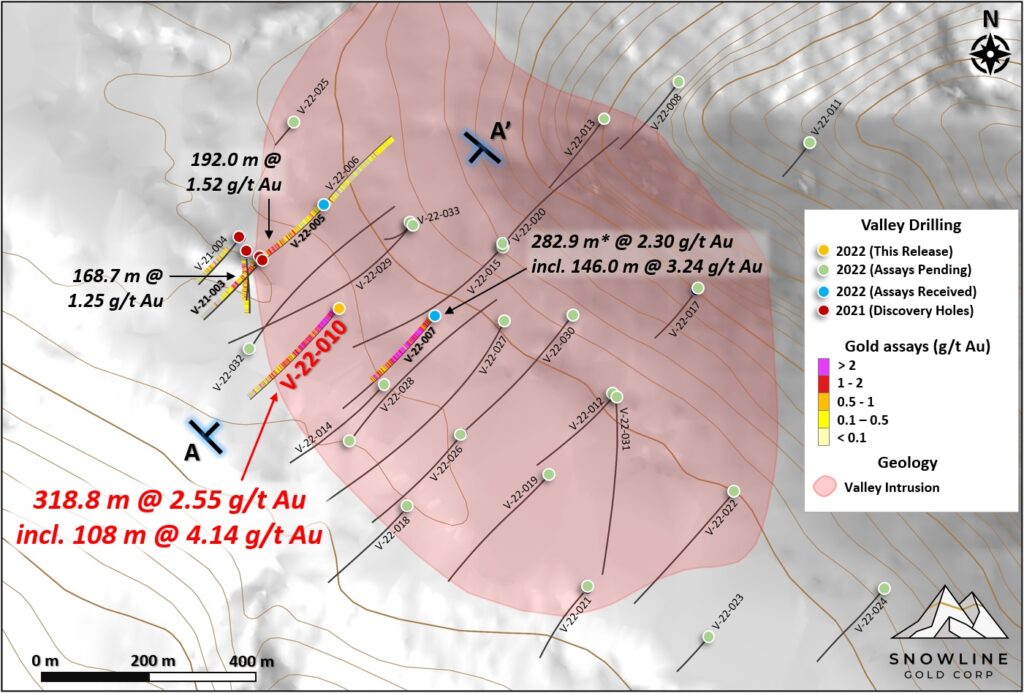
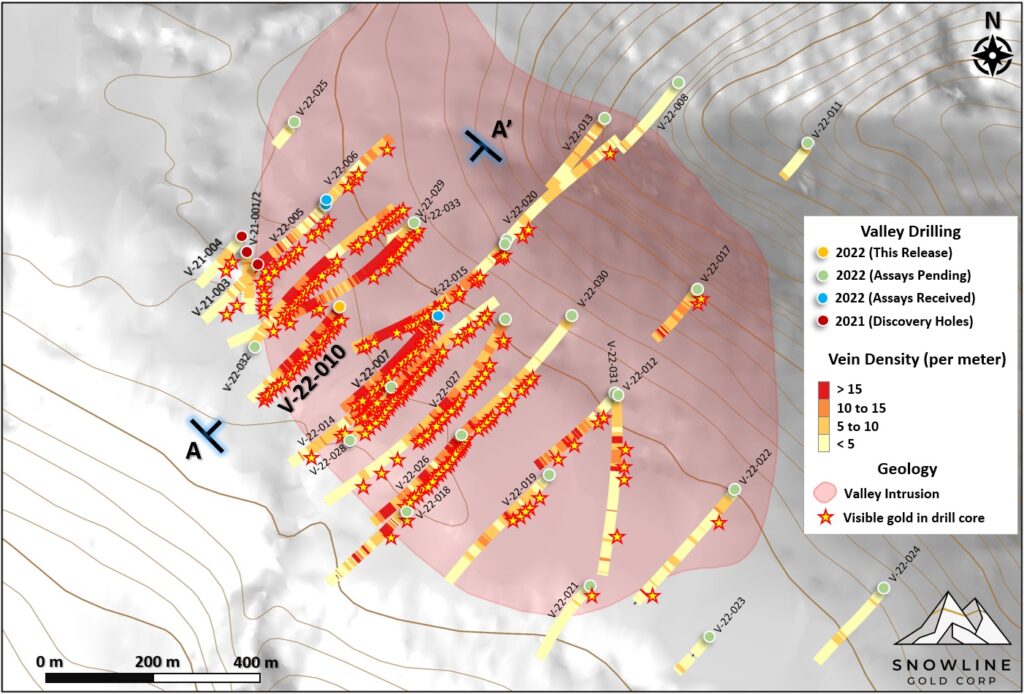
Figure 1 – 2021 and 2022 drilling at the Valley Zone, showing assays received to date (top) and vein densities alongside instances of visible gold observed during logging (bottom). Visual results indicate the presence of a large central zone within the broader Valley intrusion bearing higher vein densities. Initial analytical results for this zone consistently carry unusually high grades for a reduced intrusion-related gold system.Figure 2 – Cross-section A, showing results received (top) and vein densities alongside instances of visible gold observed during logging (bottom). V-22-029 curves into the page at depth such that the bottom of the hole is roughly 100 m behind section.Table 2 – Summary of mineralization in current holes. Gold intervals are typically long and relatively continuous, with little influence on overall interval grade from unusually high samples evidenced by strong “remainder” assays and strong values after capping assays at 10 g/t Au. *Interval widths reported; true widths of the system are not yet known, with different vein generations, orientations and grade distributions within given intervals through the bulk tonnage gold target.
HOLE V-22-029
Hole V-22-029 was collared within the Valley intrusion and to the north of the known near-surface well-mineralized corridor. The hole was a 207 m step-back along section to the northeast from the collar site for V-22-010 (318.8 m @ 2.55 g/t Au including 108.0 m @ 4.14 g/t Au from surface, see Snowline news release dated October 12, 2022), designed to test the local width of the array of steeply dipping, northwest-striking mineralized quartz veins. Additional mineralized holes V-22-005, 006, 007, 015 and 020 are located between 167 and 177 m from the collar site to the west, south and east (Figure 1), and V-22-033 was collared from the same drill pad.
The hole encountered abundant sheeted quartz veins with trace visible gold, returning 1.26 g/t Au over 558.7 m from bedrock surface at approximately 4.4 m downhole depth, including a higher-grade interval of 2.04 g/t Au over 202.0 m from 90.0 m downhole. Below this, a second zone of mineralization, averaging 0.81 g/t Au over 58.5 m from 630.5 m downhole, was encountered where the drill hole leaves the intrusion at approximately 662.3 m depth. Two 0.5 m intervals of unusually high grade mineralization were intersected at 508.5 m and 646.5 m downhole (69.50 g/t Au and 38.60 g/t Au respectively). These correspond to observations of unusually large (5 to 10 mm scale) bismuth and tellurium minerals in tight spatial association with clusters of trace visible gold.
The hole extends the known width of near surface, >1 gram per tonne gold mineralization at Valley, and demonstrates continuity of mineralization to depths greater than 400 m below surface.
As with previous holes at Valley, gold grades are carried across broad intervals, and they are not heavily affected by local high-grade (>10 g/t Au) intersections (Table 2).
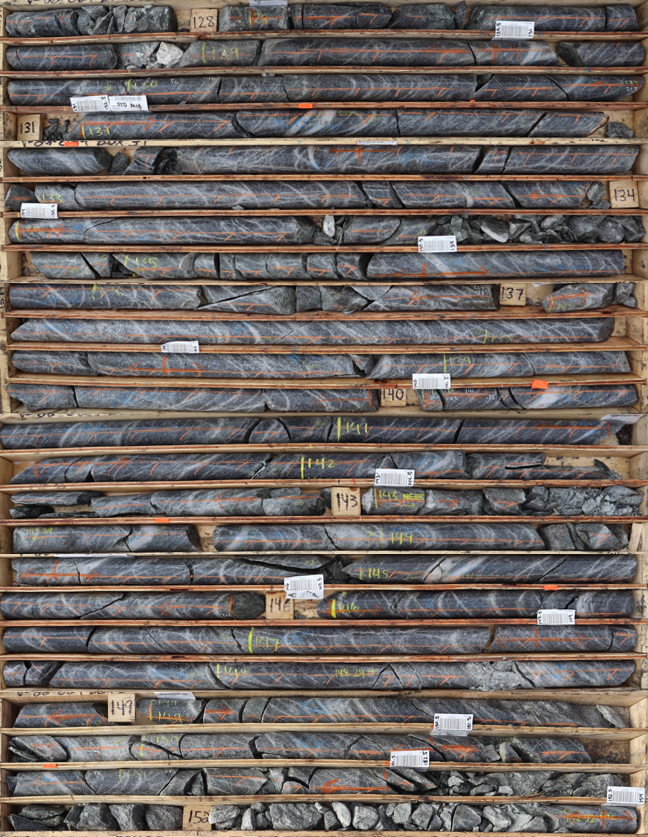
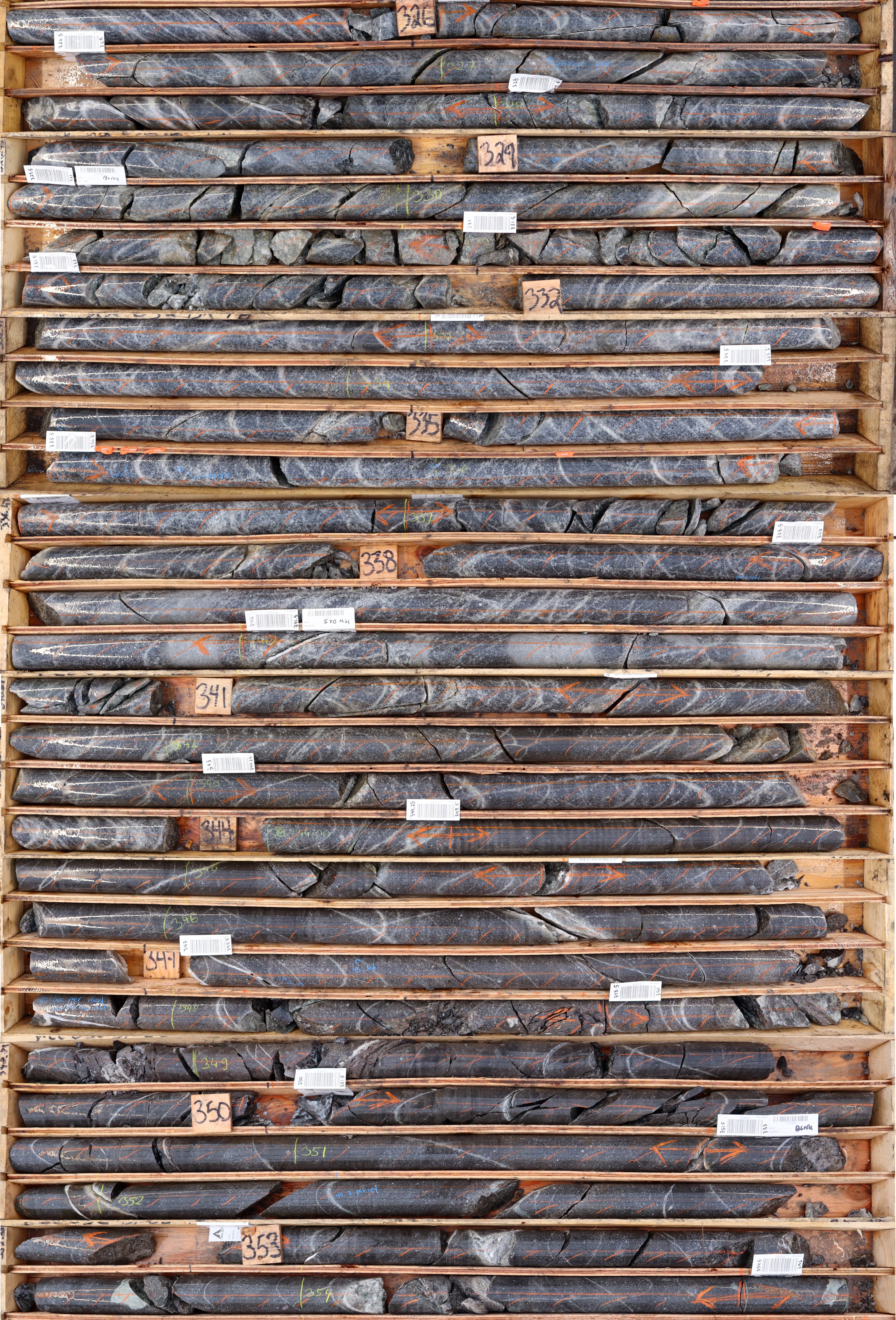
Figure 3 – Quartz vein mineralization in V-22-029, from 127.7 m to 152.7 m downhole. The hole encountered high density quartz veining father to the northeast than expected, locally expanding the width of the high-density central vein corridor. Instances of visible gold are marked by orange flags above core. The interval, previously shown in a September 20, 2022 News Release by the Company, averaged 1.47 g/t Au.
QA/QC
On receipt from the drill site, Valley’s NQ2-sized drill core was systematically logged for geological attributes, photographed and sampled at Snowline’s 2022 field camp. Sample lengths as small as 0.5 m were used to isolate features of interest, otherwise a default 1.5 m downhole sample length was used. Core was cut in half lengthwise along a pre-determined line, with one half (same half, consistently) collected for analysis and one half stored as a record. Standard reference materials, blanks and duplicate samples were inserted by Snowline personnel at regular intervals into the sample stream. Bagged samples were sealed with security tags to ensure integrity during transport. They were delivered by expeditor and by Snowline personnel to ALS Laboratories’ preparatory facility in Whitehorse, Yukon. Sample preparation was completed at different facilities in Whitehorse, Sudbury, ON, Thunder Bay, ON and Langley, BC with analyses completed in Vancouver.
ALS is accredited to ISO 17025:2005 UKAS ref 4028 for its laboratory analysis. Samples were crushed by ALS to >70% passing below 2 mm and split using a riffle splitter. 250 g splits were pulverized to >85% passing below 75 microns. A four-acid digest with an inductively coupled plasma mass spectroscopy (ICP-MS) finish was used for 48-element analysis on 0.25 g sample pulps (ALS code: ME-MS61L). All samples were analysed for gold content by fire assay with an atomic absorption spectroscopy (AAS) finish on 30 g samples (ALS code: Au-AA23). Any sample returning >10 g/t Au was reanalysed by fire assay with a gravimetric finish on a 30 g sample (ALS code: Au-GRA21).
Samples with visible gold and other samples returning >2.0 g/t Au by fire assay, along with a set of randomly selected samples, will undergo further processing, analysing the screen rejects to determine whether the screening process could introduce a sampling bias in current results by excluding coarse gold from analysis, resulting in an under-reporting of true grades. Other biases are also possible.
Results reported herein are considered preliminary following receipt of a low but expected percentage of abnormal assays from standard and blank samples inserted by the Company into the Valley sample stream. (Standard samples are prepared by a third-party laboratory to have known quantities of gold, and blank samples are known to contain very limited concentrations of gold.) Reanalysis of samples run along with these reference materials will provide greater certainty in the final assay numbers. These results will be reported if a material difference is identified between the current assays and the re-run sample batches. Based on the widespread and relatively consistent mineralization throughout mineralized zones, however, the Company does not believe that the re-analysis of this relatively small number of samples will have a significant impact on the preliminary mineralized intervals reported herein.
ABOUT ROGUE
Rogue’s Valley Zone is a newly discovered, bulk tonnage style, reduced intrusion-related gold system (RIRGS), with geological similarities to multi-million-ounce deposits currently in production like Kinross’s Fort Knox Mine in Alaska and Victoria Gold’s Eagle Mine in the Yukon. Early drill results demonstrate unusually high gold grades for such a system present near surface across intersections of hundreds of metres. Gold is associated with bismuthinite and telluride minerals hosted in sheeted quartz vein arrays along the margins of and within a one-kilometer-scale, mid-Cretaceous aged Mayo-series intrusion. Valley is an early-stage exploration project without a resource estimate, and while initial results are encouraging, the presence or absence of an economically viable orebody cannot be determined until significant additional work is completed.
The Rogue Project area hosts multiple intrusions similar to Valley along with widespread gold anomalism in stream sediment, soil and rock samples. Elsewhere, RIRGS deposits are known to occur in clusters. The Rogue Project is thus considered by the Company to have district-scale potential for additional reduced intrusion-related gold systems.
ABOUT SNOWLINE GOLD CORP.
Snowline Gold Corp. is a Yukon Territory focused gold exploration company with an eight-project portfolio covering >280,000 ha. The Company is exploring its flagship >137,000 ha Rogue and Einarson gold projects in the highly prospective yet underexplored Selwyn Basin. Snowline’s project portfolio sits within the prolific Tintina Gold Province, host to multiple million-ounce-plus gold mines and deposits including Kinross’ Fort Knox mine, Newmont’s Coffee deposit, and Victoria Gold’s Eagle Mine. The Company’s first-mover land position and extensive database provide a unique opportunity for investors to be part of multiple discoveries and the creation of a new gold district.
Figure 4 – Project location map for Snowline Gold’s eastern Selwyn Basin properties. The Valley and Gracie Zones on the Rogue are the sites of Snowline’s 2022 drill programs.
QUALIFIED PERSON
Information in this release has been prepared under supervision of and approved by Thomas K. Branson, M.Sc., P. Geo., Exploration Manager for Snowline and a Qualified Person for the purposes of National Instrument 43-101.
This news release contains certain forward-looking statements, including statements about the Company’s drill program, results, implied significance of visual inspection of drill core, and surface work and plans for exploring and expanding a new greenfield, district-scale gold system. Wherever possible, words such as “may”, “will”, “should”, “could”, “expect”, “plan”, “intend”, “anticipate”, “believe”, “estimate”, “predict” or “potential” or the negative or other variations of these words, or similar words or phrases, have been used to identify these forward-looking statements. These statements reflect management’s current beliefs and are based on information currently available to management as at the date hereof.
Forward-looking statements involve significant risk, uncertainties and assumptions. Many factors could cause actual results, performance or achievements to differ materially from the results discussed or implied in the forward-looking statements. Such factors include, among other things: risks related to uncertainties inherent in drill results and the estimation of mineral resources; and risks associated with executing the Company’s plans and intentions. These factors should be considered carefully, and readers should not place undue reliance on the forward-looking statements. Although the forward-looking statements contained in this news release are based upon what management believes to be reasonable assumptions, the Company cannot assure readers that actual results will be consistent with these forward-looking statements. These forward-looking statements are made as of the date of this news release, and the Company assumes no obligation to update or revise them to reflect new events or circumstances, except as required by law.
Vancouver, B.C., February 22, 2023: SNOWLINE GOLD CORP. (CSE: SGD) (OTCQB: SNWGF) (the “Company” or “Snowline”) is pleased to announce the appointment of Calum Morrison to the Board of Directors as an independent director.
Calum Morrison is a mining finance professional with nearly two decades of experience in business development, mergers and acquisitions, corporate strategy and capital markets.
Most recently, Mr. Morrison was the Vice President of Business Development and CFO of Great Bear Resources Ltd., and the President and CEO of Great Bear Royalties Corp. In February 2022, Kinross Gold Corp. purchased Great Bear Resources Ltd. for $1.8 billion and in September 2022 Great Bear Royalties Corp. was purchased by Royal Gold Inc. for $200 million.
Mr. Morrison previously spent several years as a senior member of Teck Resources Limited’s Corporate Development team that provided financial and technical expertise to the evaluation of mining projects around the world, including acquisitions, joint ventures, due diligence and various strategic initiatives. He also has direct capital markets experience acquired with past investment banking roles at major investment firms.
He holds a Bachelor of Science degree from Dalhousie University, and is a Chartered Financial Analyst and a Chartered Professional Accountant.
“I’m excited to be joining the Snowline Gold team and look forward to contributing to the further discovery and development of an exceptional new gold district.” commented Mr. Morrison. “Through my recent experience with Great Bear, I have seen how stakeholders can benefit from combining geologic endowment and geoscience excellence with a strong team to advance an early-stage discovery. Snowline is uniquely positioned to advance through to the next stages of asset development.”
Snowline Chair Craig Hart added that Mr. Morrison will bring valuable experience, skill sets and new perspectives to the Board with his wealth of corporate development, financial and M&A expertise. “Calum is a great addition for Snowline, not only does he bring his enthusiasm and strategic planning skills to the team, but he has first-hand experience in maximizing shareholder value for a resource company at our stage of growth.”
The Company has granted 500,000 incentive stock options to Mr. Morrison. The options are exercisable for one share each at $2.17 per share for a period of five years and are subject to the terms of the Company’s Stock Option Plan. Options are subject to vesting provisions of 20% every six months from the date of the grant.
ABOUT SNOWLINE GOLD CORP.
Snowline Gold Corp. is a Yukon Territory focused gold exploration company with an eight-project portfolio covering >280,000 ha. The Company is exploring its flagship >137,000 ha Rogue and Einarson gold projects in the highly prospective yet underexplored Selwyn Basin. Snowline’s project portfolio sits within the prolific Tintina Gold Province, host to multiple million-ounce-plus gold mines and deposits including Kinross’ Fort Knox mine, Newmont’s Coffee deposit, and Victoria Gold’s Eagle Mine. The Company’s first-mover land position and extensive database provide a unique opportunity for investors to be part of multiple discoveries and the creation of a new gold district.
This news release contains certain forward-looking statements, including statements about the Company’s drill program, results, implied significance of visual inspection of drill core, and surface work and plans for exploring and expanding a new greenfield, district-scale gold system. Wherever possible, words such as “may”, “will”, “should”, “could”, “expect”, “plan”, “intend”, “anticipate”, “believe”, “estimate”, “predict” or “potential” or the negative or other variations of these words, or similar words or phrases, have been used to identify these forward-looking statements. These statements reflect management’s current beliefs and are based on information currently available to management as at the date hereof.
Forward-looking statements involve significant risk, uncertainties and assumptions. Many factors could cause actual results, performance or achievements to differ materially from the results discussed or implied in the forward-looking statements. Such factors include, among other things: risks related to uncertainties inherent in drill results and the estimation of mineral resources; and risks associated with executing the Company’s plans and intentions. These factors should be considered carefully, and readers should not place undue reliance on the forward-looking statements. Although the forward-looking statements contained in this news release are based upon what management believes to be reasonable assumptions, the Company cannot assure readers that actual results will be consistent with these forward-looking statements. These forward-looking statements are made as of the date of this news release, and the Company assumes no obligation to update or revise them to reflect new events or circumstances, except as required by law.
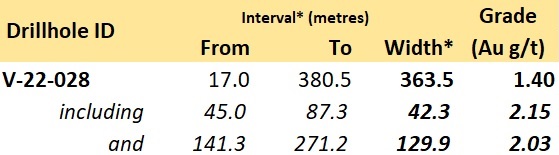
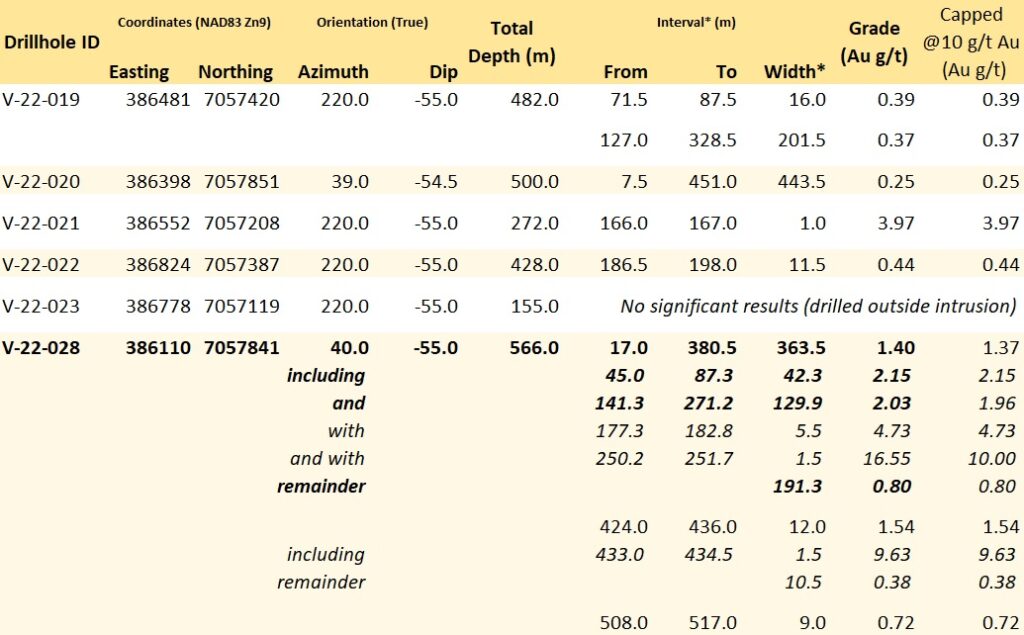
Hole V-22-028 returned 1.40 g/t Au over 363.5 m from surface, including 2.03 g/t Au over 129.9 m and 2.15 g/t Au over 42.3 m from its Valley Zone
Additional results extend known strike length of potentially economic gold grades along mineralized corridor to 720 m (open) and delineate gold-bearing quartz vein arrays along relatively underexplored eastern boundary of the Valley intrusion
Assays still pending for 7 of 32 holes (3,474 m, or 26% of 13,320 m) drilled at Valley and Gracie in 2022.
Vancouver, B.C., February 3, 2023: SNOWLINE GOLD CORP. (CSE: SGD) (OTCQB: SNWGF) (the “Company” or “Snowline”) is pleased to announce additional preliminary assay results from its 2022 drilling program at the Valley Zone, Rogue Project, Yukon. Notably, hole V-22-028 intersected a zone of sheeted quartz vein mineralization within the Valley intrusion averaging 1.40 g/t Au across 363.5 m from surface, including zones of 2.03 g/t Au over 129.9 m and 2.15 g/t Au over 42.3 m, with additional mineralization at depth (Tables 1 and 2). The hole was collared 121 m from the nearest hole (V-22-014; 285.2 m @ 1.45 g/t Au) and drilled northeast, demonstrating continuity of mineralization within Valley’s near-surface mineralized corridor. Assays remain pending for 26% (3,474 m) of the 2022 Rogue drill program.
Table 1 – Preliminary highlight summary of Snowline’s latest assay results. *Interval widths reported; true widths of the system are not yet known.
“We are continually impressed not only by the scale but by the continuity of gold mineralization at Valley,” said Scott Berdahl, CEO & Director of Snowline. “Today’s results build on earlier holes, with V-22-028 adding significant tonnage with strong gold grades. The hole demonstrates a wide breadth to the mineralized zone and grade continuity between previous holes. In addition, promising mineralization seen in V-22-019 shows potential for the near-surface higher grades to continue to the southeast, while V-22-020 shows widespread mineralization within the Valley intrusion beyond the main gold zones known to us at present. We look forward to receiving additional assays from the 2022 season as we gear up for an exciting exploration program in 2023.”
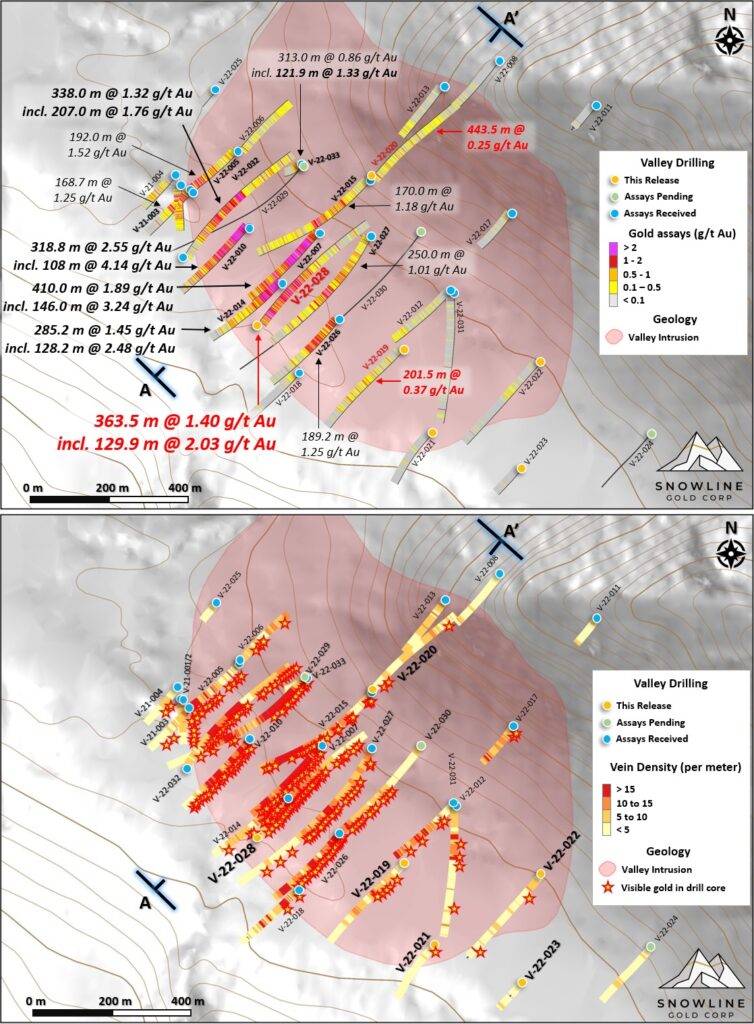
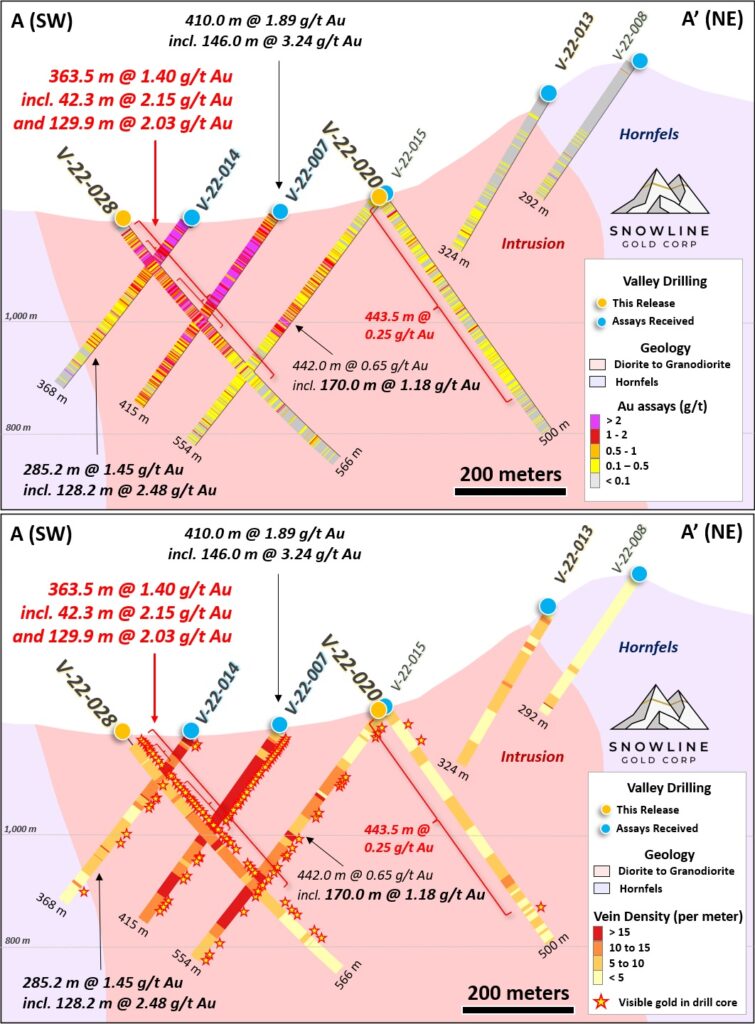
Figure 1 – 2021 and 2022 drilling at the Valley Zone, showing assays received to date (top) and vein densities alongside instances of visible gold observed during logging (bottom). Visual results indicate the presence of a large central zone within the broader Valley intrusion bearing higher vein densities. Initial analytical results for this zone consistently carry unusually high grades for a reduced intrusion-related gold system.Figure 2 – Cross-section A, showing results received (top) and vein densities alongside instances of visible gold observed during logging (bottom). V-22-028 is collared towards the southeast of the cross-section slice and runs 30-60 m in front of the other holes as shown. Views look northwest.Table 2 – Summary of mineralization in current holes. Gold intervals are typically long and relatively continuous, with little influence on overall interval grade from unusually high samples evidenced by strong “remainder” assays and strong values after capping assays at 10 g/t Au. *Interval widths reported; true widths of the system are not yet known, with different vein generations, orientations and grade distributions within given intervals through the bulk tonnage gold target.
HOLE V-22-028
Hole V-22-028 was collared near the western margin of the Valley intrusion, 121 m from the collar site for V-22-014 (285.2 m @ 1.45 g/t Au including 128.2 m @ 2.48 g/t Au, see Snowline news release dated November 15, 2022), and drilled towards the northeast into the intrusion. The hole encountered abundant sheeted quartz veins with trace visible gold, returning 1.40 g/t Au over 363.5 m from bedrock surface at approximately 17.0 m depth, including higher grade intervals of 2.15 g/t Au over 42.3 m from 45.0 m and 2.03 g/t Au over 129.9 m from 141.3 m.
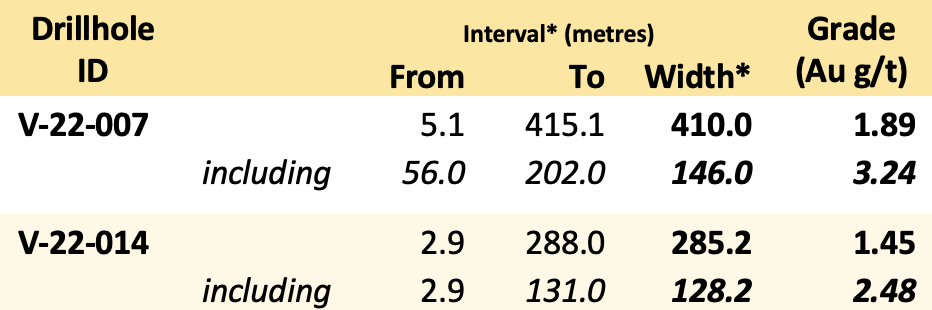
The hole extends the known width of near-surface, >1 gram per tonne gold mineralization at Valley, and demonstrates continuity of mineralization between previous holes V-22-014 and V-22-007 (410.0 m @ 1.89 g/t Au including 146.0 m @ 3.24 g/t Au, see Snowline news release dated November 15, 2022) along the western edge of the highest-grade zone of the Valley gold system encountered to date.
As with previous holes at Valley, gold grades are carried across broad intervals, and they are not heavily affected by local high-grade (>10 g/t Au) intersections (Table 2).
HOLE V-22-019
Hole V-22-019 was collared in the Valley intrusion as a step-out along strike of the well-mineralized corridor, roughly 178 m from previous hole V-22-026 (289.7 m @ 0.90 g/t Au including 189.2 m @ 1.25 g/t Au, see Snowline news release dated January 18, 2023). The hole encountered widespread low to moderate density of quartz veins hosting gold mineralization, with five instances of trace visible gold noted during logging. Two primary mineralized intervals returned 0.39 g/t Au over 16.0 m from 71.5 m downhole and 0.37 g/t Au over 201.5 m from 127.0 m downhole, extending the northwest-southeast strike length of potentially economic grades at Valley to 720 m. The system remains open. Given the depth of the observed intervals and the tendency elsewhere along the trend for higher grades near surface, the ground above and around this intersection is considered by the company to be highly prospective. Drilling planned for 2023 will test shallower parts of this area.
From bedrock surface at 19.9 m downhole depth to the bottom of consistent mineralization at 390.1 m downhole depth, including barren intervals within, V-22-019 averaged 0.29 g/t Au over 370.2 m.
HOLE V-22-020
Hole V-22-020 was collared in the Valley intrusion at the pad site of V-22-015 (442.0 m @ 0.65 g/t Au including 170.0 m @ 1.18 g/t Au, see Snowline news release dated December 22, 2022), but drilled at the opposite azimuth, towards the northeast. The hole encountered a low to moderate density of quartz veins dipping to the northeast, generally at low angles to the core axis. The top 443.5 m of the hole averaged 0.25 g/t Au from bedrock surface at 7.5 m, with generally consistent gold mineralization. As with previous hole V-22-006 (Figure 1), zones of increased grade continuity occur towards the northeastern margin of the Valley intrusion, suggesting the possibility of additional grade-controlling features in this lightly explored part of the system. The hole did not exit the intrusion by its end at 500 m downhole depth.
QA/QC
On receipt from the drill site, Valley’s NQ2-sized drill core was systematically logged for geological attributes, photographed and sampled at Snowline’s 2022 field camp. Sample lengths as small as 0.5 m were used to isolate features of interest, otherwise a default 1.5 m downhole sample length was used. Core was cut in half lengthwise along a pre-determined line, with one half (same half, consistently) collected for analysis and one half stored as a record. Standard reference materials, blanks and duplicate samples were inserted by Snowline personnel at regular intervals into the sample stream. Bagged samples were sealed with security tags to ensure integrity during transport. They were delivered by expeditor and by Snowline personnel to ALS Laboratories’ preparatory facility in Whitehorse, Yukon. Sample preparation was completed at different facilities in Whitehorse, Sudbury, ON, Thunder Bay, ON and Langley, BC with analyses completed in Vancouver.
ALS is accredited to ISO 17025:2005 UKAS ref 4028 for its laboratory analysis. Samples were crushed by ALS to >70% passing below 2 mm and split using a riffle splitter. 250 g splits were pulverized to >85% passing below 75 microns. A four-acid digest with an inductively coupled plasma mass spectroscopy (ICP-MS) finish was used for 48-element analysis on 0.25 g sample pulps (ALS code: ME-MS61L). All samples were analysed for gold content by fire assay with an atomic absorption spectroscopy (AAS) finish on 30 g samples (ALS code: Au-AA23). Any sample returning >10 g/t Au was reanalysed by fire assay with a gravimetric finish on a 30 g sample (ALS code: Au-GRA21).
Samples with visible gold and other samples returning >2.0 g/t Au by fire assay, along with a set of randomly selected samples, will undergo further processing, analysing the screen rejects to determine whether the screening process could introduce a sampling bias in current results by excluding coarse gold from analysis, resulting in an under-reporting of true grades. Other biases are also possible.
Results reported herein are considered preliminary following receipt of a low but expected percentage of abnormal assays from standard and blank samples inserted by the Company into the Valley sample stream. (Standard samples are prepared by a third-party laboratory to have known quantities of gold, and blank samples are known to contain very limited concentrations of gold.) Reanalysis of samples run along with these reference materials will provide greater certainty in the final assay numbers. These results will be reported if a material difference is identified between the current assays and the re-run sample batches. Based on the widespread and relatively consistent mineralization throughout mineralized zones, however, the Company does not believe that the re-analysis of this relatively small number of samples will have a significant impact on the preliminary mineralized intervals reported herein.
ABOUT ROGUE
Rogue’s Valley Zone is a newly discovered, bulk tonnage style, reduced intrusion-related gold system (RIRGS), with geological similarities to multi-million-ounce deposits currently in production like Kinross’s Fort Knox Mine in Alaska and Victoria Gold’s Eagle Mine in the Yukon. Early drill results demonstrate unusually high gold grades for such a system present near surface across intersections of hundreds of metres. Gold is associated with bismuthinite and telluride minerals hosted in sheeted quartz vein arrays along the margins of and within a one-kilometer-scale, mid-Cretaceous aged Mayo-series intrusion. Valley is an early-stage exploration project without a resource estimate, and while initial results are encouraging, the presence or absence of an economically viable orebody cannot be determined until significant additional work is completed.
The Rogue Project area hosts multiple intrusions similar to Valley along with widespread gold anomalism in stream sediment, soil and rock samples. Elsewhere, RIRGS deposits are known to occur in clusters. The Rogue Project is thus considered by the Company to have district-scale potential for additional reduced intrusion-related gold systems.
ABOUT SNOWLINE GOLD CORP.
Snowline Gold Corp. is a Yukon Territory focused gold exploration company with a seventeen-project portfolio covering >280,000 ha. The Company is exploring its flagship >137,000 ha Rogue and Einarson gold projects in the highly prospective yet underexplored Selwyn Basin. Snowline’s project portfolio sits within the prolific Tintina Gold Province, host to multiple million-ounce-plus gold mines and deposits including Kinross’ Fort Knox mine, Newmont’s Coffee deposit, and Victoria Gold’s Eagle Mine. The Company’s first-mover land position and extensive database provide a unique opportunity for investors to be part of multiple discoveries and the creation of a new gold district.
Figure 3 – Project location map for Snowline Gold’s eastern Selwyn Basin properties. The Valley and Gracie Zones on the Rogue are the sites of Snowline’s 2022 drill programs.
QUALIFIED PERSON
Information in this release has been prepared under supervision of and approved by Thomas K. Branson, M.Sc., P. Geo., Exploration Manager for Snowline and a Qualified Person for the purposes of National Instrument 43-101.
This news release contains certain forward-looking statements, including statements about the Company’s drill program, results, implied significance of visual inspection of drill core, and surface work and plans for exploring and expanding a new greenfield, district-scale gold system. Wherever possible, words such as “may”, “will”, “should”, “could”, “expect”, “plan”, “intend”, “anticipate”, “believe”, “estimate”, “predict” or “potential” or the negative or other variations of these words, or similar words or phrases, have been used to identify these forward-looking statements. These statements reflect management’s current beliefs and are based on information currently available to management as at the date hereof.
Forward-looking statements involve significant risk, uncertainties and assumptions. Many factors could cause actual results, performance or achievements to differ materially from the results discussed or implied in the forward-looking statements. Such factors include, among other things: risks related to uncertainties inherent in drill results and the estimation of mineral resources; and risks associated with executing the Company’s plans and intentions. These factors should be considered carefully, and readers should not place undue reliance on the forward-looking statements. Although the forward-looking statements contained in this news release are based upon what management believes to be reasonable assumptions, the Company cannot assure readers that actual results will be consistent with these forward-looking statements. These forward-looking statements are made as of the date of this news release, and the Company assumes no obligation to update or revise them to reflect new events or circumstances, except as required by law.
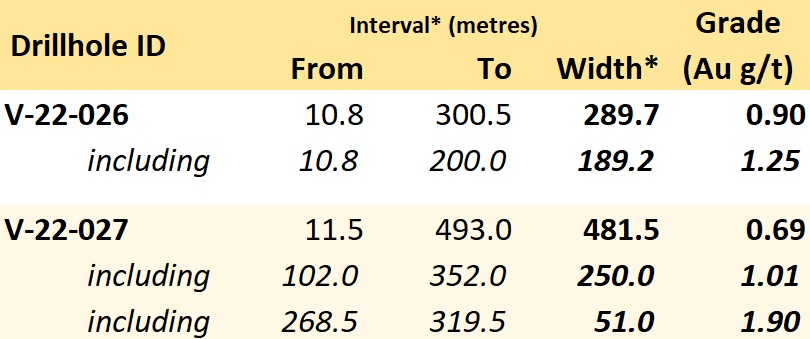
Hole V-22-026 returned 1.25 g/t Au over 189.2 m from surface within a broader mineralized interval averaging 0.90 g/t Au over 289.7 m in 170 m step-out
Hole V-22-027 returned 1.01 g/t Au over 250.0 m, within a broader mineralized interval averaging 0.69 g/t Au over 481.5 m
Results extend strike length of the mineralized core of the Valley intrusion to southeast, adding significant tonnage to known mineralization
Metallurgical testing of Valley drill core set to advance understanding of gold recovery and project economics
Assays still pending for 13 of 32 holes (6,003 m of 13,320 m) drilled at Valley and Gracie in 2022
Vancouver, B.C., January 18, 2023: SNOWLINE GOLD CORP. (CSE: SGD) (OTCQB: SNWGF) (the “Company” or “Snowline”) is pleased to announce additional preliminary assay results from its 2022 drilling program at the Valley Zone, Rogue Project, Yukon, and the commencement of metallurgical testing. Holes V-22-026 and V-22-027, drilled to the southeast of previously announced holes V-22-014 (285.2 m @ 1.45 g/t Au) and V-22-007 (410.0 m @ 1.89 g/t Au), extend the strike length of the near-surface, well-mineralized corridor at Valley by 172 m to at least 550 m (open). V-22-027 returned the longest mineralized intersection seen at Valley to date, with potential for higher grades immediately above this hole based on nearby results. Assays remain pending for 6,003 m of the 2022 Rogue drill program.
Table 1 – Preliminary highlight summary of Snowline’s latest assay results. *Interval widths reported; true widths of the system are not yet known. **Results still pending for bottom 126.0 m of this hole.
“Each round of Valley drill results has increased not just to the known extent of mineralization at the target, but to our understanding of its geology and the geometry of its highest-grade zones,” said Scott Berdahl, CEO & Director of Snowline. “The most robust and consistent mineralization we have seen so far at Valley begins in a broad zone at surface, lending itself to promising potential economics for the project, and reducing the drill metres required to advance the discovery. We eagerly await remaining 2022 drill assay results that will shed additional light on this substantial gold discovery. Our current metallurgical program will provide additional value in outlining gold recoverability, an important milestone as the project moves forward.”
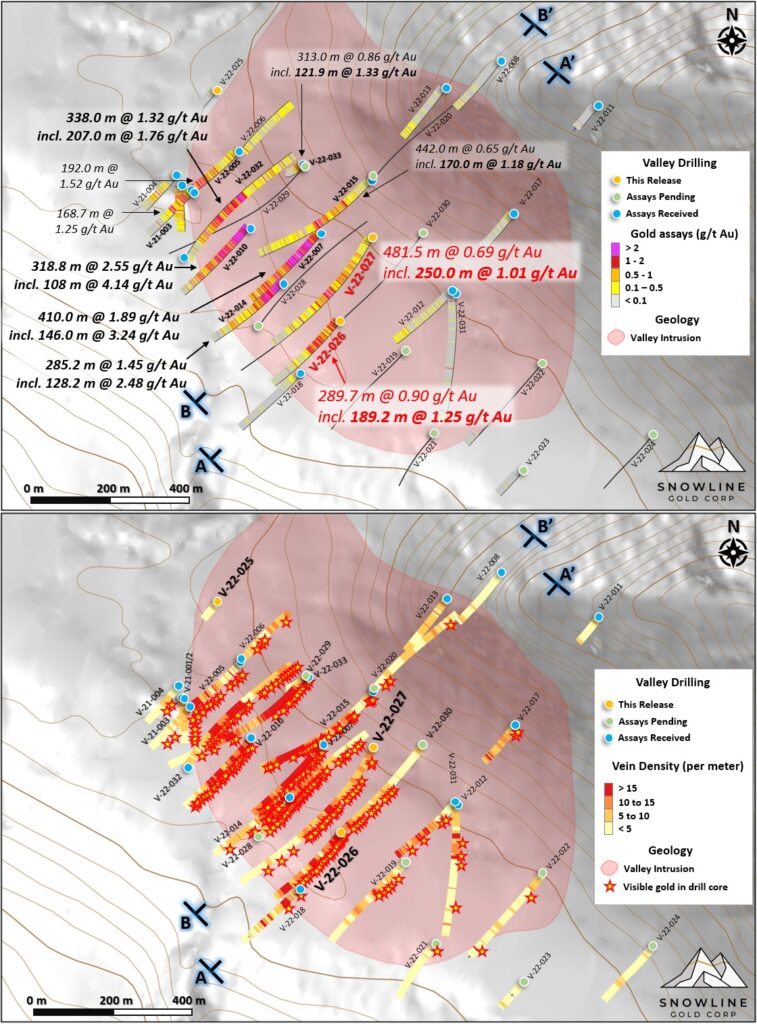
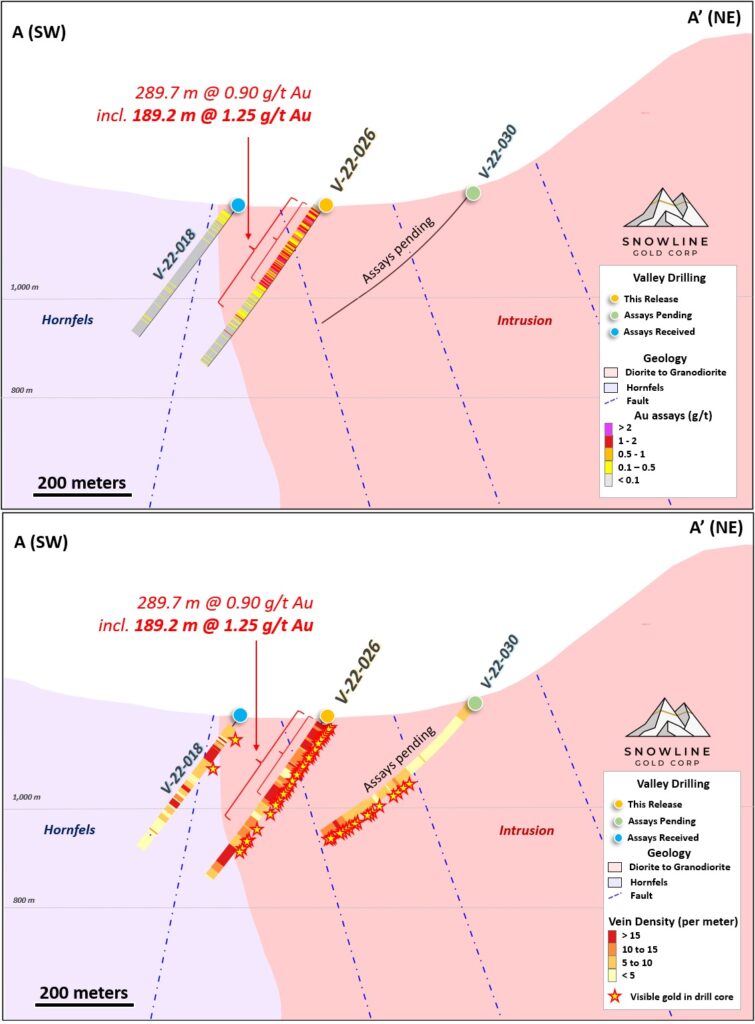
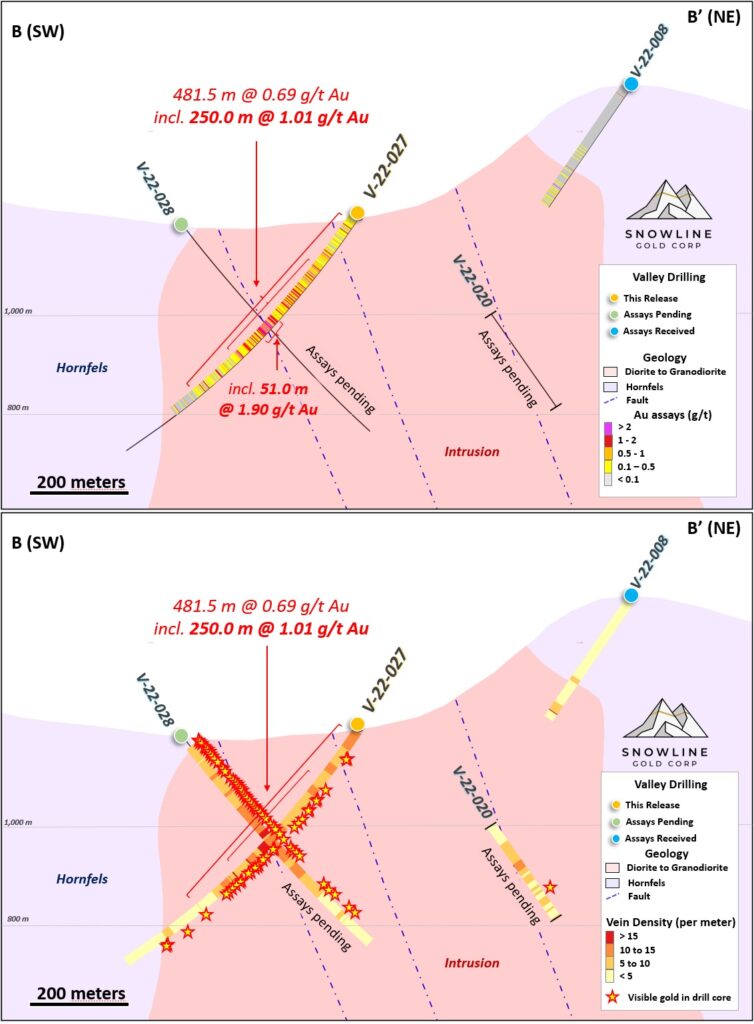
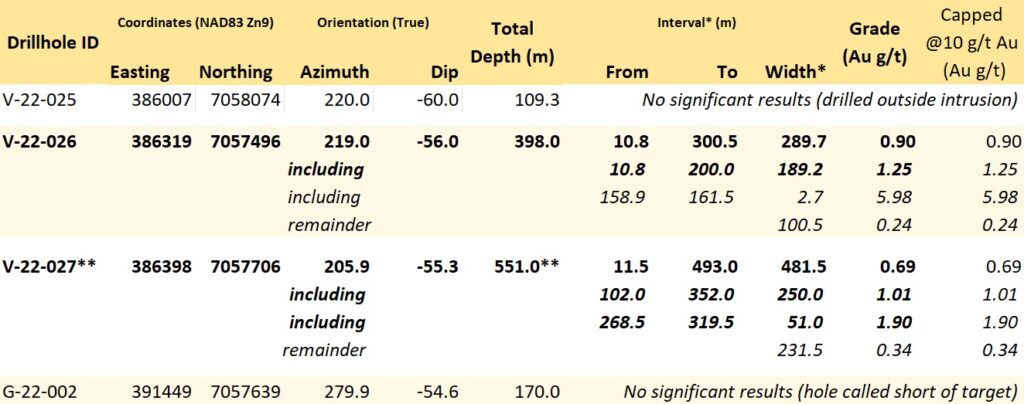
Figure 1 – 2021 and 2022 drilling at the Valley Zone, showing assays received to date (top) and vein densities alongside instances of visible gold observed during logging (bottom). Visual results indicate the presence of a large central zone within the broader Valley intrusion bearing higher vein densities. Initial analytical results for this zone consistently carry unusually high grades for a reduced intrusion-related gold system.Figure 2 – Cross section A, showing results received (top) and vein densities alongside instances of visible gold observed during logging (bottom). V-22-026 is the southeasternmost drill hole to hit a broad zone of >1 g/t Au mineralization, extending the known strike length of the bulk tonnage gold system to >0.5km. Views look northwest.Figure 3 – Cross section B, showing results received (top) and vein densities alongside instances of visible gold observed during logging (bottom). V-22-027 was drilled to intersect the mineralized system at depth before grade distributions were known and may have cut under the highest-grade zone locally. Nonetheless, it encountered robust mineralization along most of its length. Views look northwest.Table 2 – Summary of mineralization in current holes. G-22-002 is the first result from the Gracie target. The hole was called short of its target due to difficult drilling conditions and low levels of alteration. This hole was the only hole at Gracie not to encounter at least one trace instance of visible gold. *Interval widths reported; true widths of the system are not yet known. **Results still pending for bottom 126.0 m of this hole.
HOLE V-22-026
Hole V-22-026 was collared within the Valley intrusion, along strike with the intrusion’s well-mineralized corridor and 172 m from the collar site for V-22-014 (285.2 m @ 1.45 g/t Au including 128.2 m @ 2.48 g/t Au, see Snowline news release dated November 15, 2022). The hole encountered moderate to dense quartz veins and abundant visible gold in its upper sections, returning 1.25 g/t Au over 189.2 m from bedrock surface at 10.8 m depth, within a broader interval returning 0.90 g/t Au over 289.7 m. The hole cut through the western margin of the intrusion and entered lightly mineralized (generally <0.1 g/t Au, with local hits up to 0.34 g/t Au over 1.5 m) hornfels at 314.8 m downhole.
The hole extends the known strike length of broad, near-surface, gram to multiple gram per tonne gold mineralization at Valley to >550 m from mineralization encountered in 2021 drilling. This zone of mineralization remains open in multiple directions.
As with previous holes at Valley, gold grades are carried across broad intervals, and they are not heavily affected by local high-grade (>10 g/t Au) intersections (Table 2).
HOLE V-22-027
Hole V-22-027 was collared in the Valley intrusion as a step back to the northeast to test the well-mineralized central corridor between holes V-22-014 and V-22-026 at depth. The hole encountered widespread light to dense quartz vein mineralization from surface bearing bismuthinite and visible gold, before exiting the western boundary of the intrusion into hornfels at 594 m downhole depth.
Analytical results for the top 551 m of 677 m total have been received at this time. Local zones of up to 1.90 g/t Au over 51.0 m (from 268.5 m downhole) were encountered, within a wide zone of moderate to strong mineralization averaging 1.01 g/t Au across 250.0 m from 102.0 m downhole. More broadly, mineralization at grades >0.1 g/t Au is nearly continuous from 11.5 m to 493.0 m downhole, averaging 0.69 g/t Au over the 481.5 m interval and making for the longest continuously mineralized intersection (no gaps >4.5 m at <0.1 g/t Au) at the bulk tonnage Valley deposit to date. Local zones of mineralization occur below this interval, and the company awaits analytical results for the final 126 m of the hole.
Results from surrounding holes, including V-22-007 and V-22-014, suggest that the trace of V-22-027 would have passed underneath the southwestern extension of the near-surface, multiple-gram-per-tonne gold zone encountered in those holes. Drilling in 2023 will test shallower parts of this area.
METALLURGICAL TESTING
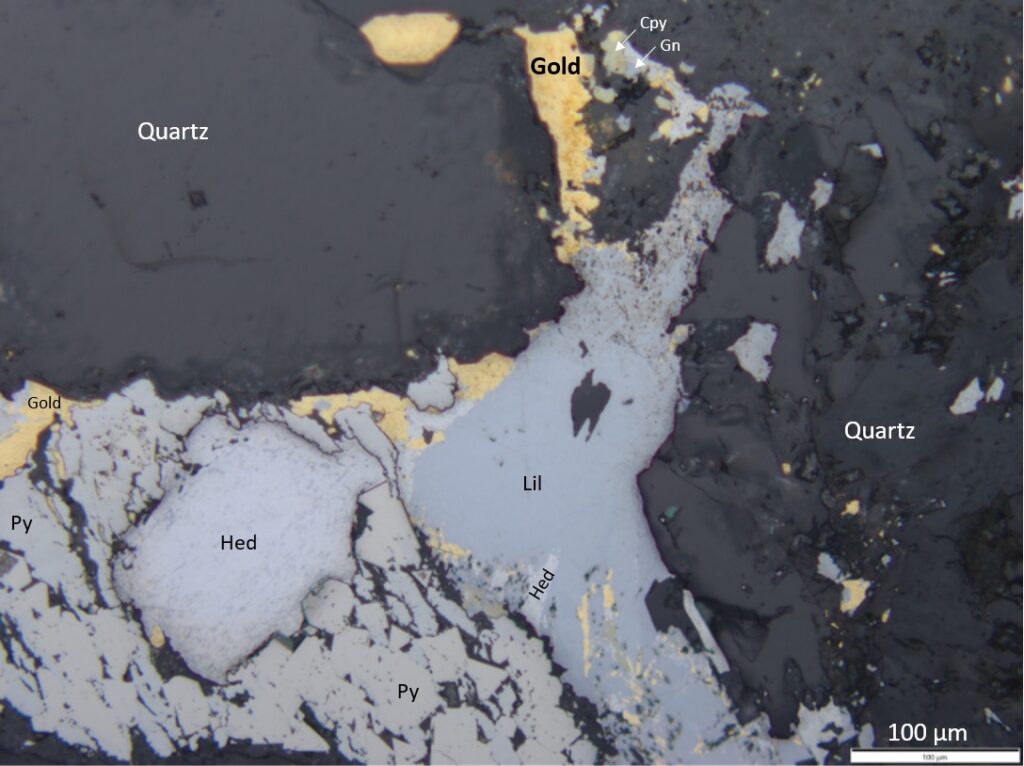
Figure 4 – Reflected light micrograph of abundant gold grains in V-22-007 at 269.8 m downhole. Gold occurs primarily in its native form, as fine grains along grain boundaries near small clusters of sulphides minerals in quartz veins. Snowline has initiated metallurgical testing of the Valley gold system to determine recovery parameters and processing options. Scale bar (bottom right) shows 100 microns, or 0.1 mm. Py=Pyrite (FeS2), Cpy=Chalcopyrite (CuFeS2), Gn=Galena (PbS), Hed=Hedleyite (Bi7Te3), Lil=Lillianite (Pb3Bi2S6).
Initial metallurgical testing of drill core from the Valley gold system is set to begin following shipping of sample material to a third-party lab. The metallurgy program will see 10 continuous composite samples of approximately 10 kg each—representing different parts of and different gold grades within the Valley intrusion—undergo head analysis, bottle roll tests and rougher flotation tests to establish potential gold recoveries for the system and relative suitability of certain potential means of ore processing.
Overall sulphur content of mineralization in Valley is low, typically <0.5% in well-mineralized zones. This, along with the distribution of abundant visible gold, is encouraging from a metallurgical perspective. Comparisons to gold systems with similar styles of mineralization, including Kinross’s Ft Knox Mine in Alaska and Victoria Gold’s Eagle Mine in the Yukon, provide further evidence that good recoveries and favourable metallurgy are likely at Valley. Each mineral system is unique, however, and thus for greater certainty, the Company is undertaking the present study.
QA/QC
On receipt from the drill site, Valley’s NQ2-sized drill core was systematically logged for geological attributes, photographed and sampled at Snowline’s 2022 field camp. Sample lengths as small as 0.5 m were used to isolate features of interest, otherwise a default 1.5 m downhole sample length was used. Core was cut in half lengthwise along a pre-determined line, with one half (same half, consistently) collected for analysis and one half stored as a record. Standard reference materials, blanks and duplicate samples were inserted by Snowline personnel at regular intervals into the sample stream. Bagged samples were sealed with security tags to ensure integrity during transport. They were delivered by expeditor and by Snowline personnel to ALS Laboratories’ preparatory facility in Whitehorse, Yukon, with analyses completed in Vancouver.
ALS is accredited to ISO 17025:2005 UKAS ref 4028 for its laboratory analysis. Samples were crushed by ALS to >70% passing below 2 mm and split using a riffle splitter. 250 g splits were pulverized to >85% passing below 75 microns. A four-acid digest with an inductively coupled plasma mass spectroscopy (ICP-MS) finish was used for 48-element analysis on 0.25 g sample pulps (ALS code: ME-MS61L). All samples were analysed for gold content by fire assay with an atomic absorption spectroscopy (AAS) finish on 30 g samples (ALS code: Au-AA23). Any sample returning >10 g/t Au was reanalysed by fire assay with a gravimetric finish on a 30 g sample (ALS code: Au-GRA21).
Samples with visible gold and other samples returning >2.0 g/t Au by fire assay, along with a set of randomly selected samples, will undergo further processing, analysing the screen rejects to determine whether the screening process could introduce a sampling bias in current results by excluding coarse gold from analysis, resulting in an under-reporting of true grades. Other biases are also possible.
Results reported herein are considered preliminary following receipt of a low but expected percentage of abnormal assays from standard and blank samples inserted by the Company into the Valley sample stream. (Standard samples are prepared by a third-party laboratory to have known quantities of gold, and blank samples are known to contain very limited concentrations of gold.) Reanalysis of samples run along with these reference materials will provide greater certainty in the final assay numbers. These results will be reported if a material difference is identified between the current assays and the re-run sample batches. Based on the widespread and relatively consistent mineralization throughout mineralized zones, however, the Company does not believe that the re-analysis of this relatively small number of samples will have a significant impact on the preliminary mineralized intervals reported herein.
ABOUT ROGUE
Rogue’s Valley Zone is a newly discovered, bulk tonnage style, reduced intrusion-related gold system (RIRGS), with geological similarities to multi-million-ounce deposits currently in production like Kinross’s Fort Knox Mine in Alaska and Victoria Gold’s Eagle Mine in the Yukon. Early drill results demonstrate unusually high gold grades for such a system present near surface across intersections of hundreds of metres. Gold is associated with bismuthinite and telluride minerals hosted in sheeted quartz vein arrays along the margins of and within a one-kilometer-scale, mid-Cretaceous aged Mayo-series intrusion. Valley is an early-stage exploration project without a resource estimate, and while initial results are encouraging, the presence or absence of an economically viable orebody cannot be determined until significant additional work is completed.
The Rogue Project area hosts multiple intrusions similar to Valley along with widespread gold anomalism in stream sediment, soil and rock samples. Elsewhere, RIRGS deposits are known to occur in clusters. The Rogue Project is thus considered by the Company to have district-scale potential for additional reduced intrusion-related gold systems.
ABOUT SNOWLINE GOLD CORP.
Snowline Gold Corp. is a Yukon Territory focused gold exploration company with a seventeen-project portfolio covering >280,000 ha. The Company is exploring its flagship >137,000 ha Rogue and Einarson gold projects in the highly prospective yet underexplored Selwyn Basin. Snowline’s project portfolio sits within the prolific Tintina Gold Province, host to multiple million-ounce-plus gold mines and deposits including Kinross’ Fort Knox mine, Newmont’s Coffee deposit, and Victoria Gold’s Eagle Mine. The Company’s first-mover land position and extensive database provide a unique opportunity for investors to be part of multiple discoveries and the creation of a new gold district.
Figure 5 – Project location map for Snowline Gold’s eastern Selwyn Basin properties. The Valley and Gracie Zones on the Rogue are the sites of Snowline’s 2022 drill programs.
QUALIFIED PERSON
Information in this release has been prepared under supervision of and approved by Thomas K. Branson, M.Sc., P. Geo., Exploration Manager for Snowline and a Qualified Person for the purposes of National Instrument 43-101.
ON BEHALF OF THE BOARD
Scott Berdahl CEO & Director
For further information, please contact: Snowline Gold Corp. +1 778 650 5485 info@snowlinegold.com
This news release contains certain forward-looking statements, including statements about the Company’s drill program, results, implied significance of visual inspection of drill core, and surface work and plans for exploring and expanding a new greenfield, district-scale gold system. Wherever possible, words such as “may”, “will”, “should”, “could”, “expect”, “plan”, “intend”, “anticipate”, “believe”, “estimate”, “predict” or “potential” or the negative or other variations of these words, or similar words or phrases, have been used to identify these forward-looking statements. These statements reflect management’s current beliefs and are based on information currently available to management as at the date hereof.
Forward-looking statements involve significant risk, uncertainties and assumptions. Many factors could cause actual results, performance or achievements to differ materially from the results discussed or implied in the forward-looking statements. Such factors include, among other things: risks related to uncertainties inherent in drill results and the estimation of mineral resources; and risks associated with executing the Company’s plans and intentions. These factors should be considered carefully, and readers should not place undue reliance on the forward-looking statements. Although the forward-looking statements contained in this news release are based upon what management believes to be reasonable assumptions, the Company cannot assure readers that actual results will be consistent with these forward-looking statements. These forward-looking statements are made as of the date of this news release, and the Company assumes no obligation to update or revise them to reflect new events or circumstances, except as required by law.
Vancouver, B.C., December 29, 2022: SNOWLINE GOLD CORP. (CSE: SGD) (US OTCQB: SNWGF) (the “Company” or “Snowline”) is pleased to reflect on its trajectory over the past 12 months. With a substantial drill discovery at the Valley gold target on the Rogue Project and a $25.2 M financing completed, 2022 was a transformative year for Snowline. The Company was founded less than two years ago to explore a previously unrecognized gold district in Canada’s Yukon. Multiple drill discoveries in this short window have led to substantial value creation, while validating and underscoring the broader exploration potential of Snowline’s target rich >280,000 ha land position in the prolific Selwyn Basin.
Snowline’s top 5 highlights from 2022:
Discovery: Drilled 318.8 m of 2.55 g/t Aufrom surface among other widely spaced highlight holes at Valley, revealing a substantial and unusually high-grade reduced intrusion-related gold system (RIRGS). 5,080 m of analytical results from the 2022 Valley drill campaign are still pending
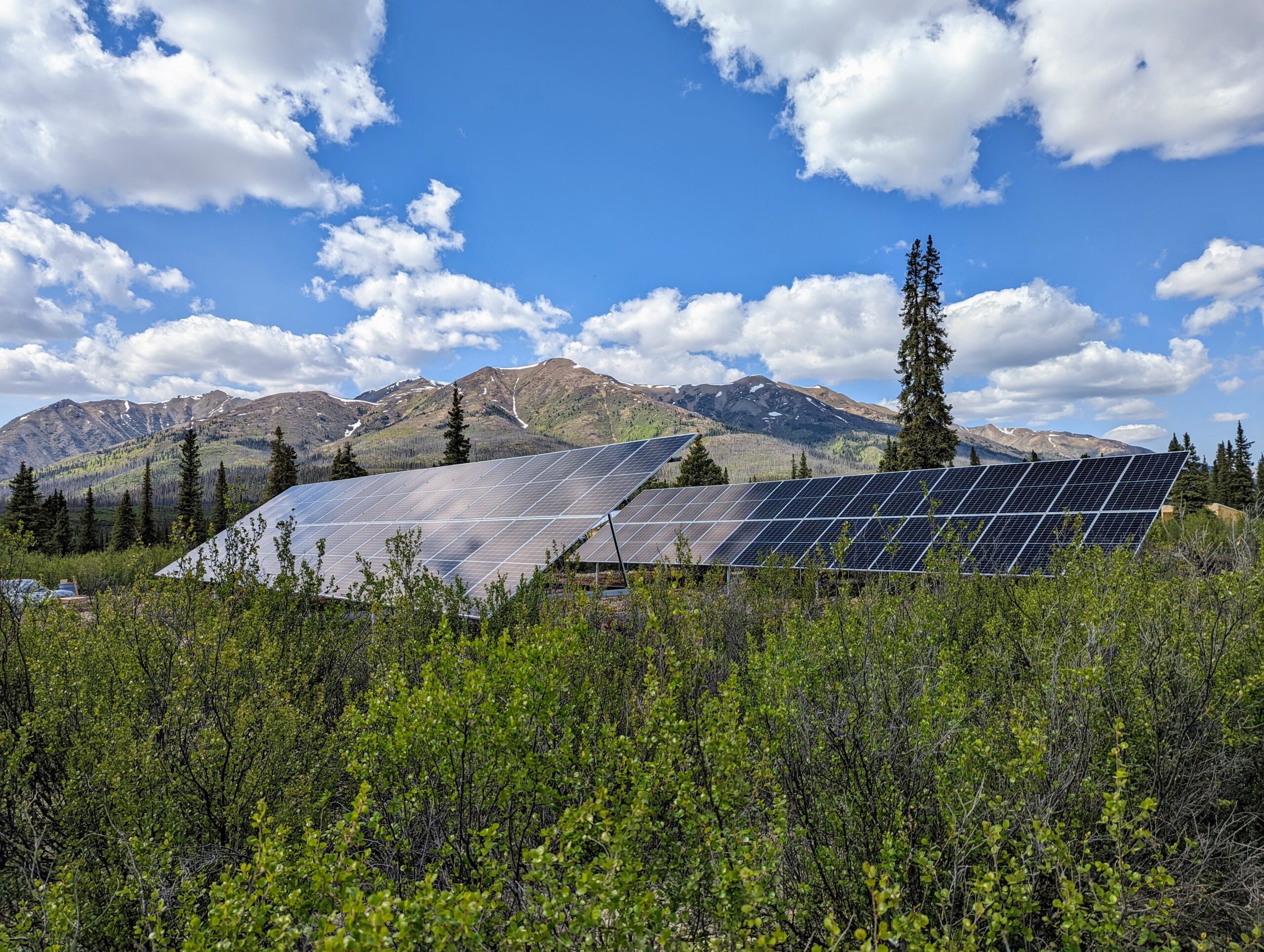
Community: Established a green energy partnership with Nacho Nyak Dun Development Corporation, providing Snowline’s main camp with a 27-kW solar power facility, reducing emissions, reducing costs, and building ties with First Nations and Yukon businesses
Growth: Recruited a strong in-house exploration and management team, with breadth and depth of experience paralleled by few companies in the junior mining space
Strength: Closed a non-brokered, $25.2 M financing, allowing Snowline to ramp up scale and pace of exploration mid-season. Snowline will enter 2023 with a treasury of $22.3 M, allowing for aggressive exploration through 2023 and beyond
Performance: 311% appreciation in share priceto date from January 1, 2022, ranking Snowline among the top exploration and mining companies globally for share price performance in 2022 and rewarding its discovery-focused approach. For the second straight year, SGD has seen triple digit returns (133% in 2021).
“In an otherwise difficult market, our efforts to build Snowline as a company and to rapidly advance our projects in an underexplored district demonstrate the value of discovery,” said Scott Berdahl, CEO & Director of Snowline. “Valley is unique in that at such an early stage, it ticks many of the boxes required of an economic gold discovery. It has scale, it has large zones of consistent mineralization with good gold grades, it has a favourable geometry, and its strongest grades—up to 4.1 g/t Au over 108.0 m—begin at surface. When we launched Snowline to explore an apparently unrecognized gold district, it’s exactly the sort of discovery we were hoping to make. The existence of Valley has strong positive implications for the potential of our other targets in the district, where we are just scratching the surface. As we look ahead to 2023, I would like to thank our investors, our strong shareholders, our team, and the many partners and supporters who have contributed to making Snowline a success.”
Additional exploration highlights from 2022 include:
Construction of 50-person “Forks” camp and adjacent 1,000 m airstrip in central location between Valley and Jupiter discoveries, efficiently servicing the Company’s Rogue, Einarson, Ursa and Cynthia projects
Acquisition of Golden Olyproject, including seven intrusions similar in age to Valley and prospective for Valley-style RIRGS gold mineralization, along with a diverse package of additional Selwyn Basin gold prospects
Significant asset expansion through staking using our proprietary regional database and in-field knowledge of regional geology and mineralization to strategically expand our claim position by 2.7x (including acquisitions) to >280,000 ha
Commencement of environmental survey work at Valley including monthly water quality monitoring, hydrology, pre-disturbance botanical inventories and wildlife surveying, providing a baseline of knowledge for future advanced stage permitting
Visible gold in Phase I drilling at Gracie, a buried intrusion 4 km east of Valley, putting Snowline 3 for 3 on discovery of visible gold in its drill programs, each on never-before-drill-tested targets. Assays for all five holes at Gracie (2,152 m) are pending
Advancement of all Yukon projects, with extensive geological, geophysical and geochemical surface programs moving new targets towards drill readiness across Snowline’s extensive Yukon exploration portfolio.
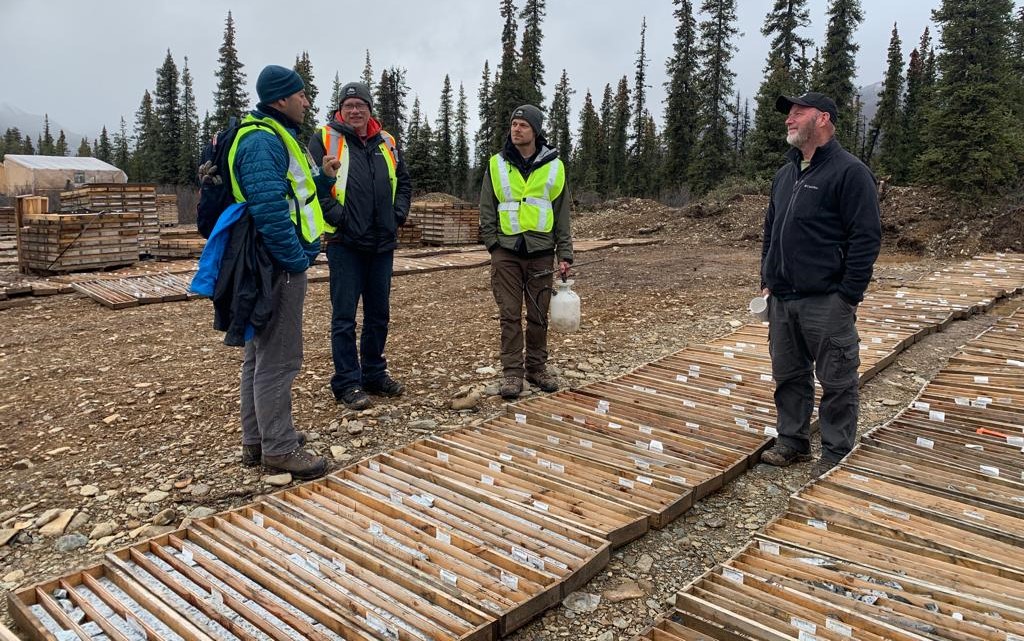
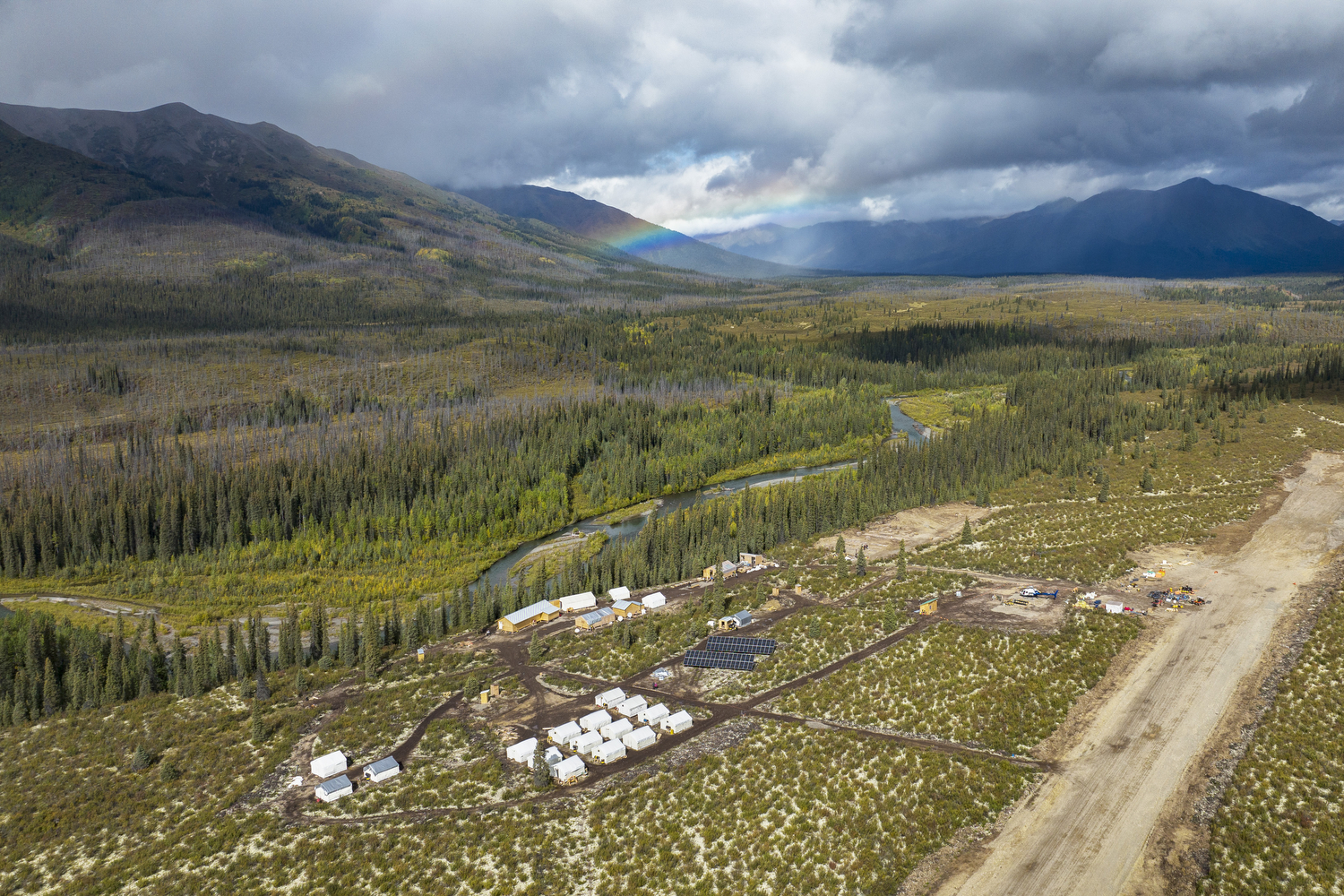
Figure 1 – Solar panels in position at Snowline’s newly built Forks Camp. Designed by Solvest Inc. the hybrid-solar generator system is among the first of its kind to be used to power a remote exploration camp in Canada.Figure 2 – Yukon Ministers Ranj Pillai (Economic Development, left) and John Streicker (Energy, Mines and Resources, second from left) discuss Valley drill core at the Forks Camp, with Snowline Chair Dr. Craig Hart (right) and CEO Scott Berdahl (second from right) in late September 2022.Figure 3 – Plan map of the Valley intrusion (pink) showing drill results received to date. Strong results from widely spaced drill holes indicate the presence of a large, consistent, and unusually high-grade reduced intrusion-related gold system. More than 5,000 m of drill results are still pending for the Valley target and are expected for Q1 2023.
2023 EXPLORATION PLANS
With a strong treasury and 3 diamond drills parked on site at Valley, Snowline is looking forward to another highly active exploration season in 2023. Through the year, the Company will adhere to its commitment to safe, environmentally sound, and socially responsible exploration, building on its economic engagement within the Yukon and further strengthening lines of communication and consultation with First Nations and Yukon communities.
The scale and nature of the 2023 program will be finalized following receipt and interpretation of remaining drill results from Valley and Gracie on the Rogue project, alongside analytical results from surface programs across Snowline’s portfolio. The Company expects to drill a significant amount at Valley in 2023 to expand, delineate and de-risk the discovery while collecting data useful to resource estimation. At the same time, the Company intends to drill multiple additional targets, using 2022 Phase I drill results from Gracie to vector towards a mineralized intrusive source to that anomaly, and performing first-pass drilling on new targets with the goal of making substantial additional discoveries.
Initial metallurgical testing of Valley material will commence in Q1 2023. The Company is also exploring options to streamline sample processing for analytical results, to avoid the long wait times for analytical results experienced in 2022.
STOCK OPTIONS
In addition, the Company announces that the Board of Directors of the Company has granted a total of 2,350,000 incentive stock options to various employees, consultants, directors, and officers of the Company. The options are exercisable for one share each at $2.88 per share for a period of five years and are subject to the terms of the Company’s Stock Option Plan. Options are subject to vesting provisions of 20% every six months from the date of the grant.
ABOUT SNOWLINE GOLD CORP.
Snowline Gold Corp. is a Yukon Territory focused gold exploration company with a seventeen-project portfolio covering >280,000 ha. The Company is exploring its flagship >137,000 ha Rogue and Einarson gold projects in the highly prospective yet underexplored Selwyn Basin. Snowline’s project portfolio sits within the prolific Tintina Gold Province, host to multiple million-ounce-plus gold mines and deposits including Kinross’ Fort Knox mine, Newmont’s Coffee deposit, and Victoria Gold’s Eagle Mine. The Company’s first-mover land position and extensive database provide a unique opportunity for investors to be part of multiple discoveries and the creation of a new gold district.
Figure 4 – Project location map for Snowline Gold’s eastern Selwyn Basin properties. The Valley and Gracie Zones on the Rogue are the sites of Snowline’s 2022 drill programs. Staking in the latter part of 2022 brings the total area to >280,000 ha.
QUALIFIED PERSON
Information in this release has been prepared under supervision of and approved by Thomas K. Branson, M.Sc., P. Geo., Exploration Manager for Snowline and a Qualified Person for the purposes of National Instrument 43-101.
ON BEHALF OF THE BOARD
Scott Berdahl
CEO & Director
For further information, please contact: Snowline Gold Corp. +1 778 650 5485 info@snowlinegold.com
This news release contains certain forward-looking statements, including statements about the Company’s drill program, results, implied significance of visual inspection of drill core, and and plans for exploring and expanding a new greenfield, district-scale gold system. Wherever possible, words such as “may”, “will”, “should”, “could”, “expect”, “plan”, “intend”, “anticipate”, “believe”, “estimate”, “predict” or “potential” or the negative or other variations of these words, or similar words or phrases, have been used to identify these forward-looking statements. These statements reflect management’s current beliefs and are based on information currently available to management as at the date hereof.
Forward-looking statements involve significant risk, uncertainties and assumptions. Many factors could cause actual results, performance or achievements to differ materially from the results discussed or implied in the forward-looking statements. Such factors include, among other things: risks related to uncertainties inherent in drill results and the estimation of mineral resources; and risks associated with executing the Company’s plans and intentions. These factors should be considered carefully, and readers should not place undue reliance on the forward-looking statements. Although the forward-looking statements contained in this news release are based upon what management believes to be reasonable assumptions, the Company cannot assure readers that actual results will be consistent with these forward-looking statements. These forward-looking statements are made as of the date of this news release, and the Company assumes no obligation to update or revise them to reflect new events or circumstances, except as required by law.
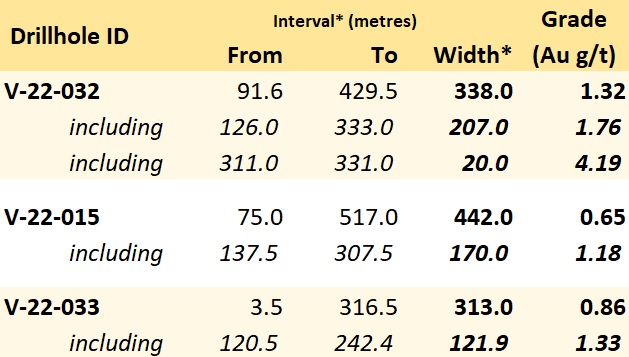
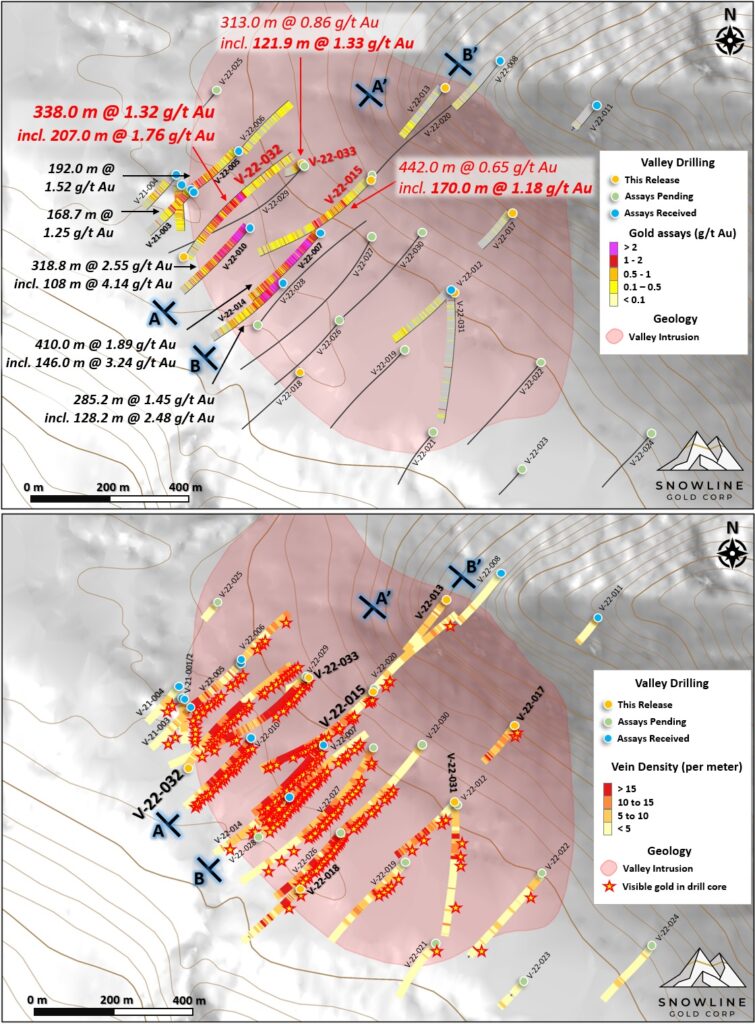
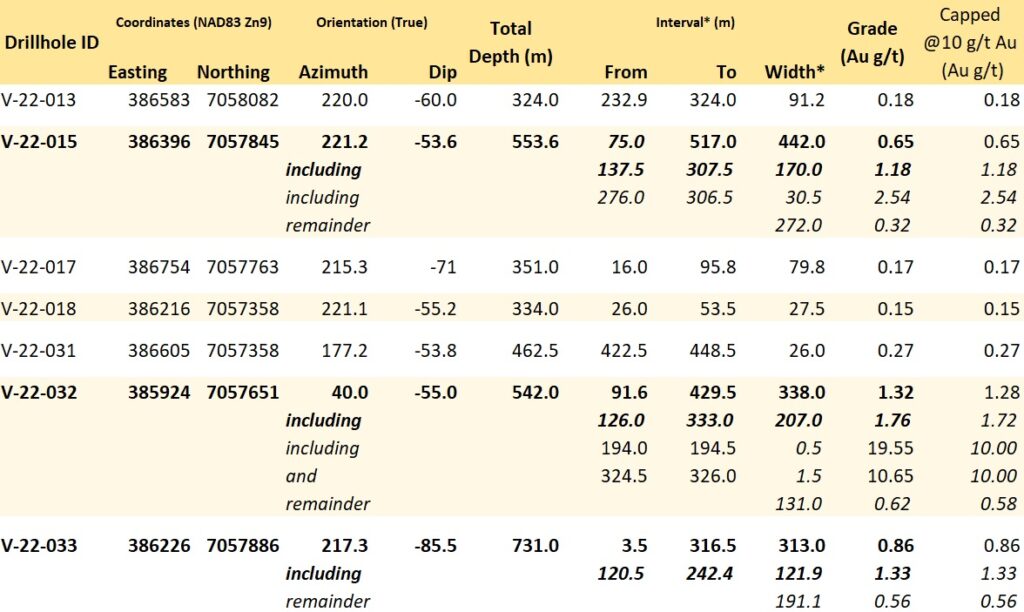
Hole V-22-032 returned 1.76 g/t Au over 207.0 m within a broader mineralized interval averaging 1.32 g/t Au over 338.0 m
Hole V-22-015 returned 1.18 g/t Au over 170.0 m, within a broader mineralized interval averaging 0.65 g/t Au over 442.0 m in 182 m step-back across system width
Results further demonstrate scale and strong continuity within unusually high-grade reduced intrusion-related gold system
Assays still pending for 17 of 32 holes (7,232 m of 13,320 m) drilled at Valley and Gracie in 2022
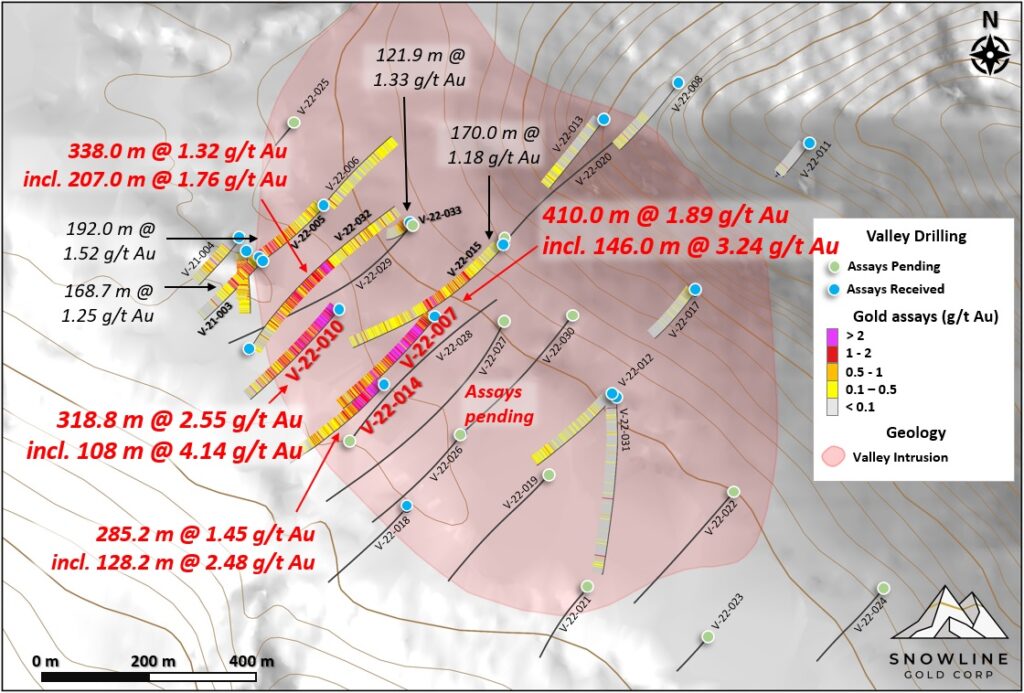
Vancouver, B.C., December 22, 2022: SNOWLINE GOLD CORP. (CSE: SGD) (OTCQB: SNWGF) (the “Company” or “Snowline”) is pleased to announce additional preliminary assay results from its 2022 drilling program at the Valley Zone, Rogue Project, Yukon. Notably, hole V-22-032 intersected a zone of sheeted quartz vein mineralization within the Valley intrusion averaging 1.72 g/t Au over 207.0 m within a broader mineralized zone averaging 1.32 g/t Au over 338.0 m (Tables 1 and 2). The entire hole, including barren sections, averaged 0.93 g/t Au across 532.7 m, ending in mineralized rock. The hole was collared 166 m from any other hole and drilled northeast to test the system between previously announced V-22-005 (192.0 m @ 1.52 g/t Au) and V-22-010 (318.8 m @ 2.5 g/t Au).
Table 1 – Preliminary highlight summary of Snowline’s latest assay results. *Interval widths reported; true widths of the system are not yet known. The geometry of the mineralized zone is not determined by any individual vein nor structure and depends instead on the broader geometries of various vein arrays.
“The latest results from Valley continue to demonstrate substantial scale and strong grades for a reduced intrusion-related gold system,” said Scott Berdahl, CEO & Director of Snowline. “Holes V-22-015 and 032 add considerably to the known tonnage of well-mineralized rock in Valley’s central zone. The shape, the size, and the distribution of grades that we’re seeing at Valley—with many of the highest grades encountered to date starting at surface—bode very well for the potential economics of the discovery. We eagerly await remaining 2022 assay results and their contributions to our understanding of this large mineralized system, with more than 5,000 m still to come at Valley and all five holes (>2,000 m) still pending from our nearby Gracie target.”
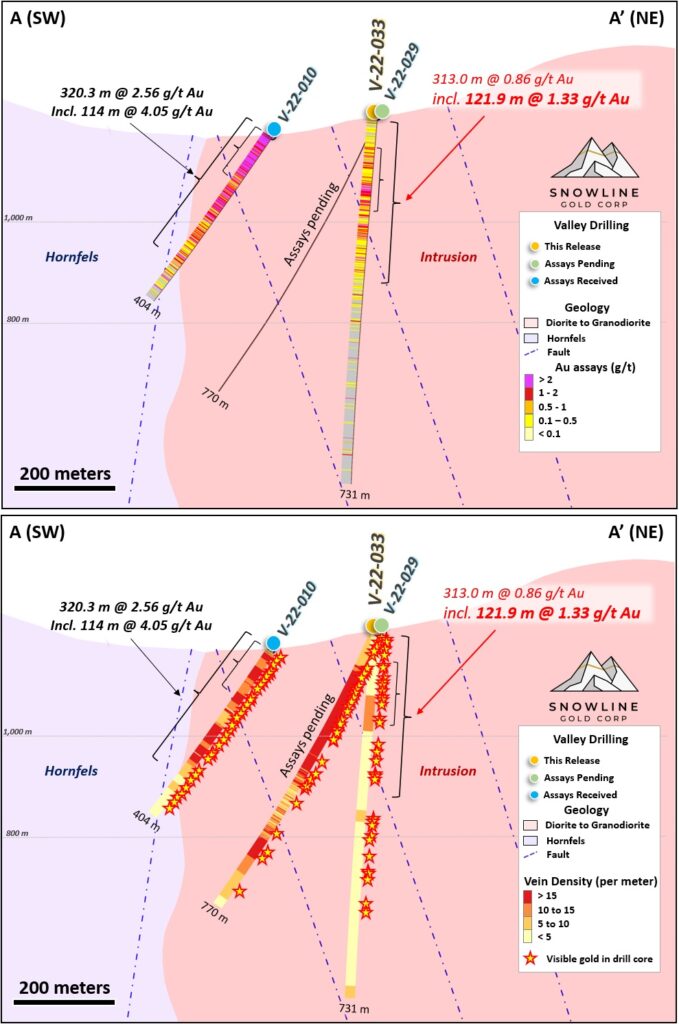
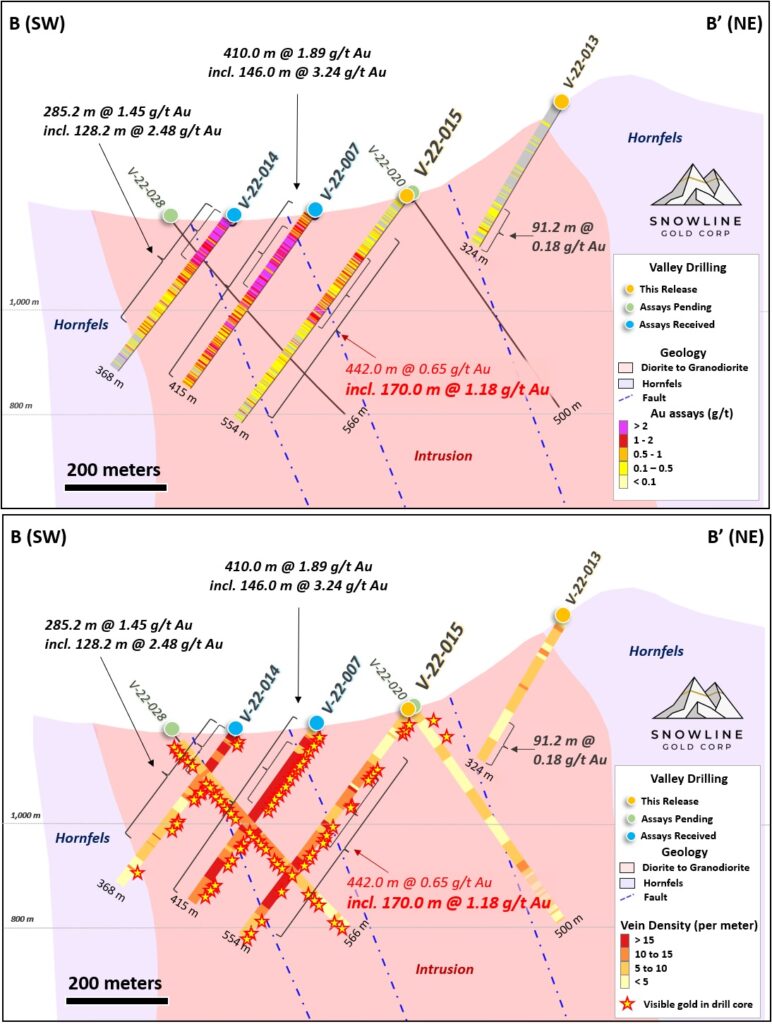
Figure 1 – 2021 and 2022 drilling at the Valley Zone, showing assays received to date (top) and vein densities alongside instances of visible gold observed during logging (bottom). Visual results indicate the presence of a large central zone within the broader Valley intrusion bearing higher vein densities. Initial analytical results for this zone consistently carry unusually high grades for a reduced intrusion-related gold system.Figure 2 – Cross section A, showing results received (top) and vein densities alongside instances of visible gold observed during logging (bottom). V-22-033 expands the known width of the mineralized zone locally to >300m. While broad zones of continuous mineralization were not encountered at depth in this location, local intervals were. The deepest >1 g/t Au assay ran 1.2 g/t Au over 1.5 m from 672.5 m downhole. Views look northwest.Figure 3 – Cross section B, showing results received to date (top) and vein densities alongside instances of visible gold observed during logging (bottom). V-22-015 was drilled to test the relatively high-grade mineralization encountered in V-22-014 and V-22-007 across a wider width and at depth.Views look northwest.Table 2 – Summary of mineralization in current holes. Several zones of higher grades are present but capping these at 10 g/t Au shows that the intervals are carried by robust mineralization along large zones within these higher-grade holes. *Interval widths reported; true widths of the system are not yet known.
HOLE V-22-032
Hole V-22-032 was collared in hornfels sedimentary rock west of the Valley intrusion, and drilled northeast, roughly perpendicular to the general southwest orientation of most drill holes to date at Valley. On crossing into the intrusion at 91.6 m downhole, it averaged 1.32 g/t Au over the subsequent 338.0 m, with a general increase in grades towards a gradational boundary between intrusive phases encountered at 341.5 m downhole. The 100.5 m above this boundary averaged 2.03 g/t Au, including a 20 m stretch near the boundary averaging 4.19 g/t Au.
The hole demonstrates further continuity of near-surface, gram to multiple gram per tonne gold mineralization encountered in previous holes at Valley. The darker, porphyritic phase of the intrusion below the boundary may be a driver for higher grades in the lighter, medium-grained granodiorite above.
As with previous holes at Valley, gold grades are carried across broad intervals, and they are not heavily affected by local high-grade (>10 g/t Au) intersections (Table 2).
Figure 4 – Intrusive phase boundary in V-22-032, from 325.5 m to 351.7 m downhole, showing heavily veined, medium grained granodiorite above roughly 341.5 m downhole, and a darker, fine-grained porphyritic phase of the intrusion below. The polyphase nature of the intrusion is thought to be a factor in the dense veining and unusually high gold grades encountered at Valley.
HOLE V-22-015
Hole V-22-015 was collared in the Valley intrusion on section with V-22-007 (410.0 m @ 1.89 g/t Au including 146.0 m @ 3.24 g/t Au) and V-22-014 (285.2 m @ 1.45 g/t Au including 128.2 m @ 2.48 g/t Au, see Snowline news release dated November 15, 2022), stepped back roughly 182 m from V-22-007 to better test the width and depth of the system. V-22-015 encountered its highest grades within the upper two thirds of the hole. A broad zone of high quartz vein density encountered lower in the hole (Figure 3) loosely correlates with zones of the same darker, porphyritic phase of the intrusion seen in V-22-032. The abrupt decrease in vein density at the intrusive phase boundary observed in that hole is thus not present in V-22-015. Instead, a decrease in the regularity of bismuthinite and visible gold in the lower parts of V-22-015 compared to veins seen roughly 200 m vertically above in V-22-007 appears to correspond to a decrease in gold values.
ABOUT ROGUE
Rogue’s Valley Zone is a newly discovered, bulk tonnage style, reduced intrusion-related gold system (RIRGS), with geological similarities to multi-million-ounce deposits currently in production like Kinross’s Fort Knox Mine in Alaska and Victoria Gold’s Eagle Mine in the Yukon. Early drill results demonstrate unusually high gold grades for such a system present near surface across intersections of hundreds of metres. Gold is associated with bismuthinite and telluride minerals hosted in sheeted quartz vein arrays along the margins of and within a one-kilometer-scale, mid-Cretaceous aged Mayo-series intrusion. Valley is an early-stage exploration project without a resource estimate, and while initial results are encouraging, the presence or absence of an economically viable orebody cannot be determined until significant additional work is completed.
The Rogue Project area hosts multiple intrusions similar to Valley along with widespread gold anomalism in stream sediment, soil and rock samples. Elsewhere, RIRGS deposits are known to occur in clusters. The Rogue Project is thus considered by the Company to have district-scale potential for additional reduced intrusion-related gold systems.
UPDATE ON PENDING ANALYTICAL RESULTS
The long processing times for analytical results are understood to be due to operational constraints and high sample volumes at the Whitehorse sample preparation facility. To help manage this backlog, ALS Laboratories has sent various Snowline sample batches to Langley, BC, Sudbury, ON and Thunder Bay, ON. The Company expects this to decrease turnaround time for analytical results on the remaining 17 holes drilled at Rogue in 2022. As evidenced by the available results for late-season holes like V-22-032, this process also randomizes the expected order of receipt of remaining analytical results.
QA/QC
On receipt from the drill site, Valley’s NQ2-sized drill core was systematically logged for geological attributes, photographed and sampled at Snowline’s 2022 field camp. Sample lengths as small as 0.5 m were used to isolate features of interest, otherwise a default 1.5 m downhole sample length was used. Core was cut in half lengthwise along a pre-determined line, with one half (same half, consistently) collected for analysis and one half stored as a record. Standard reference materials, blanks and duplicate samples were inserted by Snowline personnel at regular intervals into the sample stream. Bagged samples were sealed with security tags to ensure integrity during transport. They were delivered by expeditor and by Snowline personnel to ALS Laboratories’ preparatory facility in Whitehorse, Yukon, with analyses completed in Vancouver.
ALS is accredited to ISO 17025:2005 UKAS ref 4028 for its laboratory analysis. Samples were crushed by ALS to >70% passing below 2 mm and split using a riffle splitter. 250 g splits were pulverized to >85% passing below 75 microns. A four-acid digest with an inductively coupled plasma mass spectroscopy (ICP-MS) finish was used for 48-element analysis on 0.25 g sample pulps (ALS code: ME-MS61L). All samples were analysed for gold content by fire assay with an atomic absorption spectroscopy (AAS) finish on 30 g samples (ALS code: Au-AA23). Any sample returning >10 g/t Au was reanalysed by fire assay with a gravimetric finish on a 30 g sample (ALS code: Au-GRA21).
Samples with visible gold and other samples returning >2.0 g/t Au by fire assay, along with a set of randomly selected samples, will undergo further processing, analysing the screen rejects to determine whether the screening process could introduce a sampling bias in current results by excluding coarse gold from analysis, resulting in an under-reporting of true grades. Other biases are also possible.
Results reported herein are considered preliminary following receipt of a low but expected percentage of abnormal assays from standard and blank samples inserted by the Company into the Valley sample stream. (Standard samples are prepared by a third-party laboratory to have known quantities of gold, and blank samples are known to contain very limited concentrations of gold.) Reanalysis of samples run along with these reference materials will provide greater certainty in the final assay numbers. These results will be reported if a material difference is identified between the current assays and the re-run sample batches. Based on the widespread and relatively consistent mineralization throughout mineralized zones, however, the Company does not believe that the re-analysis of this relatively small number of samples will have a significant impact on the preliminary mineralized intervals reported herein.
ABOUT SNOWLINE GOLD CORP.
Snowline Gold Corp. is a Yukon Territory focused gold exploration company with a seventeen-project portfolio covering >254,000 ha. The Company is exploring its flagship >111,000 ha Einarson and Rogue gold projects in the highly prospective yet underexplored Selwyn Basin. Snowline’s project portfolio sits within the prolific Tintina Gold Province, host to multiple million-ounce-plus gold mines and deposits including Kinross’ Fort Knox mine, Newmont’s Coffee deposit, and Victoria Gold’s Eagle Mine. The Company’s first-mover land position and extensive database provide a unique opportunity for investors to be part of multiple discoveries and the creation of a new gold district.
Figure 5 – Project location map for Snowline Gold’s eastern Selwyn Basin properties. The Valley and Gracie Zones on the Rogue are the sites of Snowline’s 2022 drill programs.
QUALIFIED PERSON
Information in this release has been prepared under supervision of and approved by Thomas K. Branson, M.Sc., P. Geo., Exploration Manager for Snowline and a Qualified Person for the purposes of National Instrument 43-101.
This news release contains certain forward-looking statements, including statements about the Company’s drill program, results, implied significance of visual inspection of drill core, and surface work and plans for exploring and expanding a new greenfield, district-scale gold system. Wherever possible, words such as “may”, “will”, “should”, “could”, “expect”, “plan”, “intend”, “anticipate”, “believe”, “estimate”, “predict” or “potential” or the negative or other variations of these words, or similar words or phrases, have been used to identify these forward-looking statements. These statements reflect management’s current beliefs and are based on information currently available to management as at the date hereof.
Forward-looking statements involve significant risk, uncertainties and assumptions. Many factors could cause actual results, performance or achievements to differ materially from the results discussed or implied in the forward-looking statements. Such factors include, among other things: risks related to uncertainties inherent in drill results and the estimation of mineral resources; and risks associated with executing the Company’s plans and intentions. These factors should be considered carefully, and readers should not place undue reliance on the forward-looking statements. Although the forward-looking statements contained in this news release are based upon what management believes to be reasonable assumptions, the Company cannot assure readers that actual results will be consistent with these forward-looking statements. These forward-looking statements are made as of the date of this news release, and the Company assumes no obligation to update or revise them to reflect new events or circumstances, except as required by law.
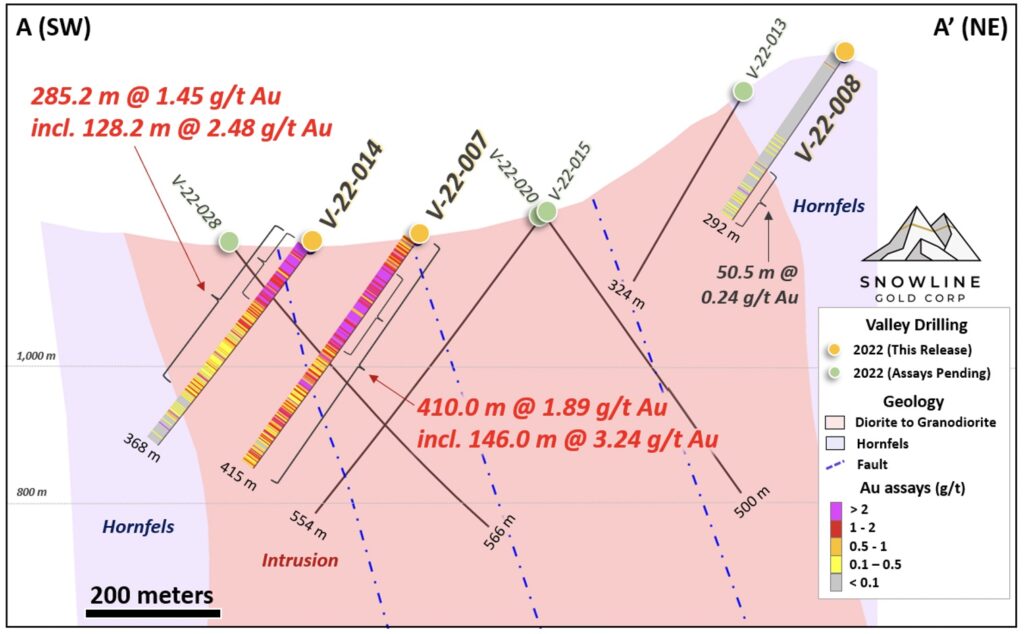
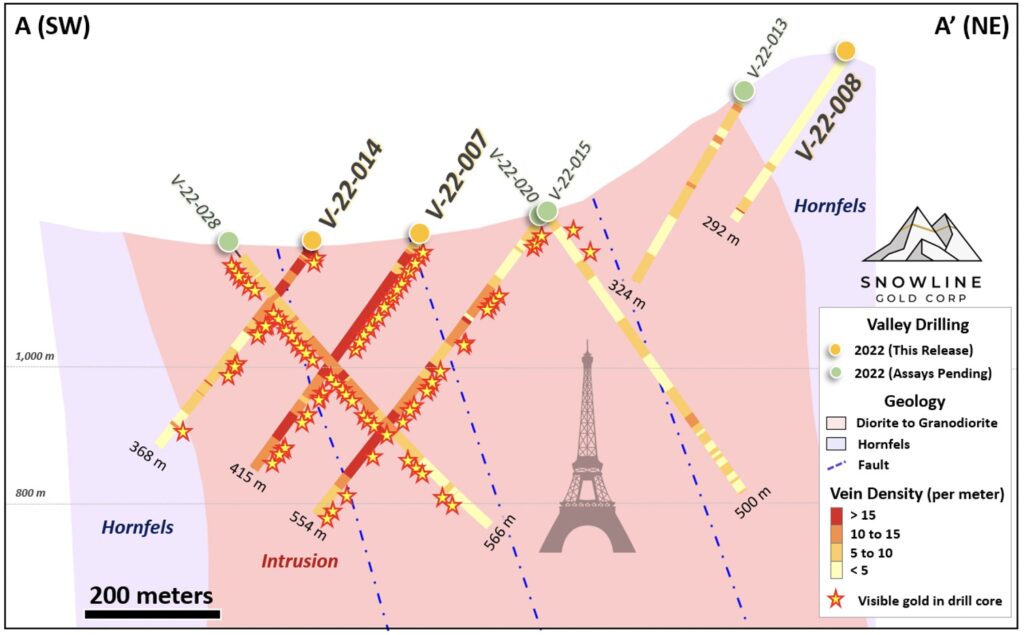
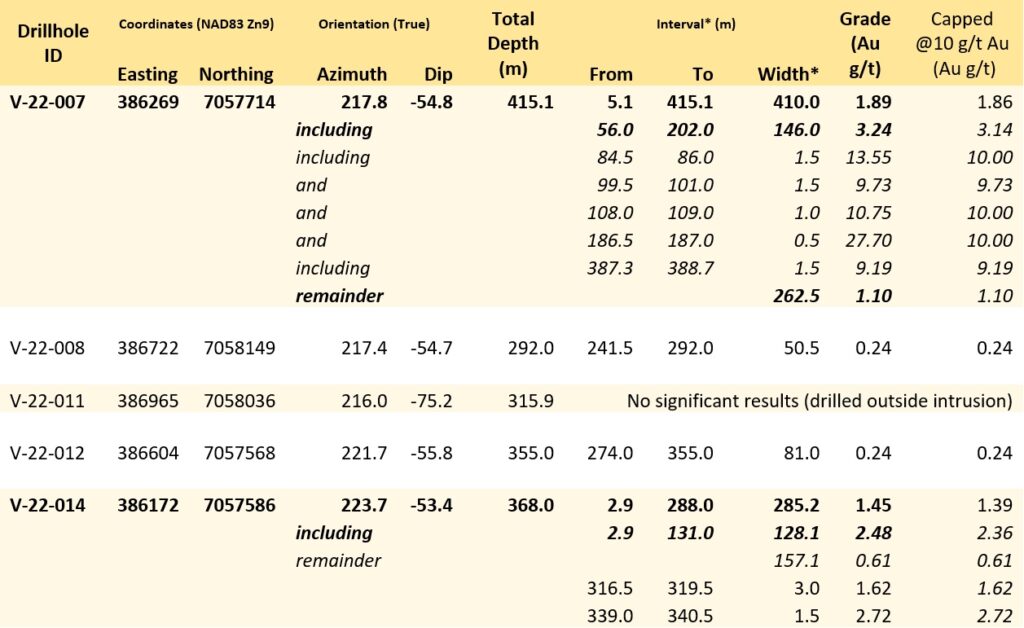
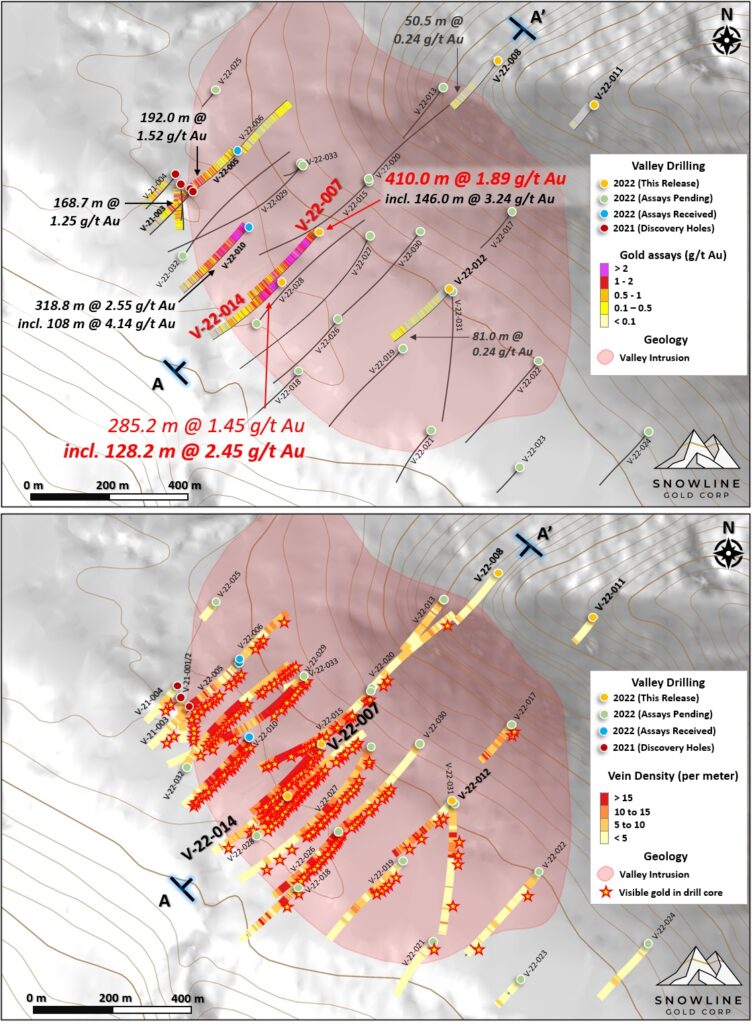
Hole V-22-014 returned 1.45 g/t Au over 285.2 m, including 2.48 g/t Au over 128.2 mfrom bedrock surface in 160 m step-out from previous holes
Full results in for V-22-007 returned 1.89 g/t Au over 410.0 m (entire length in mineralization), including previously announced 3.24 g/t Au over 146.0 m
Results further demonstrate scale and strong continuity within unusually high-grade reduced intrusion-related gold system
Assays still pending for 24 of 32 holes (10,530 m of 13,320 m) drilled at Valley and Gracie in 2022
Vancouver, B.C., November 15, 2022: SNOWLINE GOLD CORP. (CSE: SGD) (OTCQB: SNWGF) (the “Company” or “Snowline”) is pleased to announce additional preliminary[1] assay results from its 2022 drilling program at the Valley Zone, Rogue Project, Yukon. Notably, hole V-22-014 intersected a broad zone of sheeted quartz vein mineralization within the Valley intrusion averaging 2.48 g/t Au over 128.2 m from bedrock surface at 2.8 m downhole within a broader zone of 1.45 g/t Au over 285.2 m (Tables 1 and 2). The hole was collared 160 m from the nearest previously announced hole. Full results have also been received for V-22-007, which is mineralized along its entire 410.0 m length from bedrock surface, averaging 1.89 g/t Au along the length of the hole.
Table 1 – Preliminary highlight summary of V-22-007 and V-22-014, including previously reported upper 282.9 m (@ 2.30 g/t Au from 5.1 m) in V-22-007. *Interval widths reported; true widths of the system are not yet known. The geometry of the mineralized corridor is not determined by any individual vein nor structure and depends instead on the broader distribution of the many thousands of small, mineralized quartz veins present at Valley.
“Hole V-22-014 is the latest step-out drill hole to add significantly to the prospective scale and grade of our unfolding gold discovery at Valley,” said Scott Berdahl, CEO & Director of Snowline. “The continuity of strong grades from Valley’s central zone, seen both within holes along hundreds of metres and between holes spaced hundreds of metres apart, demonstrates the presence of a large and robust, unusually rich bulk tonnage gold system. Comparable quartz vein densities—often with numerous instances of trace visible gold—in many holes for which assays have yet to be received have the potential to carry similar grades. With analytical results pending for nearly 80% of our 2022 drilling, we expect further significant growth to this discovery in the coming weeks and months.”
Figure 1 – Cross section showing V-22-007 & 014 results received to date (top) and vein densities alongside instances of visible gold observed during logging (bottom). Hole 014 suggests continuity of high-grade (>2 g/t Au) mineralization in 007 to surface, and it broadens the zone to the southwest. Views look northwest. Note that V-22-028 is slightly in the foreground (see Figure 2). As a scale reference, the Eiffel Tower is 330 m tall from base to tip.Table 2 – Summary of mineralization in current holes. Several zones of higher grades are present but capping these at 10 g/t Au shows that the intervals are carried by robust mineralization along much of the holes. Hole V-22-008, while not a highlight of the batch by grade, averaged 0.24 g/t Au across its final 50 m on entering the Valley intrusion, roughly 635 m from previously reported holes. Hole V-22-012 is dominated by a distinct vein orientation with an E-W trend, as opposed to the NW-SE orientation in the central zone. *Interval widths reported; true widths of the system are not yet known.
HOLE V-22-014
Hole V-22-014 was collared in the Valley intrusion, 160 m southwest of hole V-22-007 and 165 m southeast of hole V-22-010 (318.8 m @ 2.55 g/t Au including 108.0 m @ 4.14 g/t Au, see Snowline news release dated October 12, 2022). The hole demonstrates lateral and vertical continuity of near-surface, multi-gram-per-tonne gold mineralization encountered in previous holes at Valley (Figures 1 and 2).
V-22-014 encountered high densities of gold-bearing quartz veins in its top 128.2 m and remained largely in mineralization until exiting into hornfels sedimentary rocks at 326 m depth. The last >1.0 g/t Au gold assay occurs as 2.02 g/t Au over 1.5 m from 339.0-340.5 m downhole, within hornfels sedimentary rocks. Gold is typically associated with bismuthinite and telluride minerals in sheeted to near stockwork quartz veins. Overall sulphide content of the system is very low.
As with previous holes in this zone, V-22-014 exhibits a relatively high degree of consistency in gold grade. Of the top 128.2 m, 59 of 103 samples assayed higher than 2.0 g/t Au—representing 71.2 m (non-contiguous) or 55.5% of the downhole interval. While high grades of up to 22.4 g/t (1.4 oz/ton) Au are present, they are not primary drivers of the broader mineralized intervals. Applying a cap at 10 g/t Au reduces the top 128.2 m of the hole by just 4.8% to 2.36 g/t Au, while the broader 285.2 m interval is affected less, dropping 4.1% to 1.39 g/t Au (Table 2).
Figure 2 – 2022 drilling at the Valley Zone, showing assays received to date (top) and vein densities alongside instances of visible gold observed during logging (bottom). Visual results indicate the presence of a large central zone within the broader Valley intrusion bearing higher vein densities. Initial analytical results for this zone consistently carry unusually high grades for a reduced intrusion-related gold system.
ABOUT ROGUE
The geological setting and style of mineralization at Rogue’s Valley Zone indicate the presence of a bulk tonnage gold target, with similarities to Kinross’s Fort Knox Mine in Alaska and Victoria Gold’s Eagle Mine in the Yukon. Gold is associated with bismuthinite and telluride minerals hosted in sheeted quartz vein arrays along the margins of a mid-Cretaceous aged Mayo-series intrusion. The Rogue Project hosts multiple intrusions of similar age and affinity to that at Valley along with widespread gold anomalism in stream sediment, soil and rock samples. The project is thus considered by the Company to have district-scale potential for reduced-intrusion related gold systems.
Valley is an early-stage exploration project without a resource estimate, and the presence or absence of an economically viable orebody cannot be determined until significant additional work is completed.
Figure 3 – Project location map for Snowline Gold’s eastern Selwyn Basin properties. The Valley and Gracie Zones on the Rogue are the sites of Snowline’s 2022 drill programs.
TOTAL METRES DRILLED – CORRECTION
Due to a tallying error that saw two holes summed twice, total drilling meterage for the 2022 season was incorrectly reported on Snowline’s October 12, 2022 news release as 14,495 m. In fact, a total of 13,320 m was drilled by the Company on its Rogue project in 2022, with 11,168 m drilled at Valley in 27 holes and 2,152 m drilled at the nearby Gracie target in 5 holes. Presently, results for 2,789 m (8 holes) have been received from Valley, with assays pending for the remaining 8,378 m (19 holes). Results for all holes at Gracie remain pending.
QA/QC
On receipt from the drill site, Valley’s NQ2-sized drill core was systematically logged for geological attributes, photographed and sampled at Snowline’s 2022 field camp. Sample lengths as small as 0.5 m were used to isolate features of interest, otherwise a default 1.5 m downhole sample length was used. Core was cut in half lengthwise along a pre-determined line, with one half (same half, consistently) collected for analysis and one half stored as a record. Standard reference materials, blanks and duplicate samples were inserted by Snowline personnel at regular intervals into the sample stream. Bagged samples were sealed with security tags to ensure integrity during transport. They were delivered by expeditor and by Snowline personnel to ALS Laboratories’ preparatory facility in Whitehorse, Yukon, with analyses completed in Vancouver.
ALS is accredited to ISO 17025:2005 UKAS ref 4028 for its laboratory analysis. Samples were crushed by ALS to >70% passing below 2 mm and split using a riffle splitter. 250 g splits were pulverized to >85% passing below 75 microns. A four-acid digest with an inductively coupled plasma mass spectroscopy (ICP-MS) finish was used for 48-element analysis on 0.25 g sample pulps (ALS code: ME-MS61L). All samples were analysed for gold content by fire assay with an atomic absorption spectroscopy (AAS) finish on 30 g samples (ALS code: Au-AA23). Any sample returning >10 g/t Au was reanalysed by fire assay with a gravimetric finish on a 30 g sample (ALS code: Au-GRA21).
Samples with visible gold and other samples returning >2.0 g/t Au by fire assay, along with a set of randomly selected samples, will undergo further processing, analysing the screen rejects to determine whether the screening process could introduce a sampling bias in current results by excluding coarse gold from analysis, resulting in an under-reporting of true grades. Other biases are also possible.
Results reported herein are considered preliminary following receipt of a low but expected percentage of abnormal assays from standard and blank samples inserted by the Company into the Valley sample stream. (Standard samples are prepared by a third-party laboratory to have known quantities of gold, and blank samples are known to contain very limited concentrations of gold.) Reanalysis of samples run along with these reference materials will provide greater certainty in the final assay numbers. These results will be reported if a material difference is identified between the current assays and the re-run sample batches. Based on the widespread and consistent mineralization throughout mineralized zones, however, the Company does not believe that the re-analysis of this relatively small number of samples will have a significant impact on the preliminary mineralized intervals reported herein.
ABOUT SNOWLINE GOLD CORP.
Snowline Gold Corp. is a Yukon Territory focused gold exploration company with a seventeen-project portfolio covering >254,000 ha. The Company is exploring its flagship >111,000 ha Einarson and Rogue gold projects in the highly prospective yet underexplored Selwyn Basin. Snowline’s project portfolio sits within the prolific Tintina Gold Province, host to multiple million-ounce-plus gold mines and deposits including Kinross’ Fort Knox mine, Newmont’s Coffee deposit, and Victoria Gold’s Eagle Mine. The Company’s first-mover land position and extensive database provide a unique opportunity for investors to be part of multiple discoveries and the creation of a new gold district.
[1] These results are considered preliminary as a small percentage of the Company’s QA/QC insertions of blanks and standard reference materials returned values of outside of acceptable limits. This is not an unusual nor necessarily unexpected failure rate. In response, five samples on either side of failed insertions will be reanalysed along with the insertions themselves. Given the scale and general consistency of the gold mineralization across the holes where insertions did pass QA/QC screening, the Company deems these preliminary results to be strongly indicative of overall grade. Final assay results may be updated in a future release.
QUALIFIED PERSON
Information in this release has been prepared under supervision of and approved by Thomas K. Branson, M.Sc., P. Geo., Exploration Manager for Snowline and a Qualified Person for the purposes of National Instrument 43-101.
This news release contains certain forward-looking statements, including statements about the Company’s drill program, results, implied significance of visual inspection of drill core, and surface work and plans for exploring and expanding a new greenfield, district-scale gold system. Wherever possible, words such as “may”, “will”, “should”, “could”, “expect”, “plan”, “intend”, “anticipate”, “believe”, “estimate”, “predict” or “potential” or the negative or other variations of these words, or similar words or phrases, have been used to identify these forward-looking statements. These statements reflect management’s current beliefs and are based on information currently available to management as at the date hereof. Forward-looking statements involve significant risk, uncertainties and assumptions. Many factors could cause actual results, performance or achievements to differ materially from the results discussed or implied in the forward-looking statements. Such factors include, among other things: risks related to uncertainties inherent in drill results and the estimation of mineral resources; and risks associated with executing the Company’s plans and intentions. These factors should be considered carefully, and readers should not place undue reliance on the forward-looking statements. Although the forward-looking statements contained in this news release are based upon what management believes to be reasonable assumptions, the Company cannot assure readers that actual results will be consistent with these forward-looking statements. These forward-looking statements are made as of the date of this news release, and the Company assumes no obligation to update or revise them to reflect new events or circumstances, except as required by law.
Vancouver, B.C., October 21, 2022: SNOWLINE GOLD CORP. (CSE: SGD) (US OTC: SNWGF) (the “Company” or “Snowline”) is pleased to announce it has completed the previously announced acquisition of a large portfolio of Yukon Territory exploration assets from StrikePoint Gold Inc. (TSXV: SKP), an arm’s length party, in exchange for (i) the payment of $500,000 in cash, and (ii) the issuance of 500,000 common shares (the “Consideration Shares”) of the Company.
“The StrikePoint portfolio comprises ten gold properties in the Yukon’s Selwyn Basin, complementing our existing portfolio and exploration efforts well,” said Scott Berdahl, CEO & Director of Snowline. “Most notably, the ‘Golden Oly’ project covers at least seven distinct reduced intrusion-related gold targets. Each target is geologically similar to our ongoing Valley discovery on our Rogue Project. Based on that success, this is ground we would have staked if it were open. Instead, we have acquired not just the properties, but also extensive geochemical, geophysical and geological datasets which will accelerate our exploration efforts—all for roughly the cost of staking. We will apply our growing knowledge of reduced intrusion-related gold systems and of the Selwyn Basin to build on our track record of discovery.”
Figure 1 – Project location map for Snowline Gold’s flagship eastern Selwyn Basin properties. Golden Oly is located south of Rogue, covering a cluster of intrusion-related gold targets in the vicinity of the Yukon’s North Canol Road.
The Consideration Shares are subject to a statutory hold period of four months and one day, expiring on February 21, 2023, in accordance with applicable Canadian securities laws. The Consideration Shares are also subject to a contractual hold period of six months, expiring on April 20, 2023.
ABOUT SNOWLINE GOLD CORP.
Snowline Gold Corp. is a Yukon Territory focused gold exploration company with a seventeen-project portfolio covering >254,000 ha. The Company is exploring its flagship >111,000 ha Einarson and Rogue gold projects in the highly prospective yet underexplored Selwyn Basin. Snowline’s project portfolio sits within the prolific Tintina Gold Province, host to multiple million-ounce-plus gold mines and deposits including Kinross’ Fort Knox mine, Newmont’s Coffee deposit, and Victoria Gold’s Eagle Mine. The Company’s first-mover land position and extensive database provide a unique opportunity for investors to be part of multiple discoveries and the creation of a new gold district.
ON BEHALF OF THE BOARD
Scott Berdahl CEO & Director
For further information, please contact: Snowline Gold Corp. +1 778 650 5485 info@snowlinegold.com
This news release contains certain forward-looking statements, including statements related to the similarities of the StrikePoint portfolio to the Company’s ongoing Valley discovery on its Rogue Project, the acceleration of exploration efforts, the opportunity for investors to be part of multiple discoveries and the creation of a new gold district. Wherever possible, words such as “may”, “will”, “should”, “could”, “expect”, “plan”, “intend”, “anticipate”, “believe”, “estimate”, “predict” or “potential” or the negative or other variations of these words, or similar words or phrases, have been used to identify these forward-looking statements. These statements reflect management’s current beliefs and are based on information currently available to management as at the date hereof.
Forward-looking statements involve significant risk, uncertainties and assumptions. Many factors could cause actual results, performance or achievements to differ materially from the results discussed or implied in the forward-looking statements. Such factors include, among other things: risks related to uncertainties inherent in drill results and the estimation of mineral resources; and risks associated with executing the Company’s plans and intentions. These factors should be considered carefully, and readers should not place undue reliance on the forward-looking statements. Although the forward-looking statements contained in this news release are based upon what management believes to be reasonable assumptions, the Company cannot assure readers that actual results will be consistent with these forward-looking statements. These forward-looking statements are made as of the date of this news release, and the Company assumes no obligation to update or revise them to reflect new events or circumstances, except as required by law.
Hole V-22-010 returned 2.55 g/t Au over 318.8 m, including 4.14 g/t Au over 108.0 mfrom bedrock surface
Hole demonstrates continuity of multi-gram mineralization seen in V-22-007 and expands width of high-grade central corridor at Valley
Assays still pending for 28.3 of 32 holes (13,182 m of 14,495 m) drilled at Valley and Gracie in 2022
Monthly environmental baseline monitoring commenced at Valley.
Vancouver, B.C., October 12, 2022: SNOWLINE GOLD CORP. (CSE: SGD) (OTCQB: SNWGF) (the “Company” or “Snowline”) is pleased to announce additional preliminary* assay results from its 2022 drilling program at the Valley Zone, Rogue Project, Yukon. Hole V-22-010 intersected a broad zone of sheeted quartz vein mineralization within the Valley intrusion averaging 2.55 g/t Au over 318.8 m from bedrock surface at 3.0 m downhole (Tables 1 and 2). The hole was collared more than 165 m from any previously announced hole, and it expands to the southeast the known width of the zone of high vein densities within the Valley intrusion (Figures 1 and 2).
Table 1 – Preliminary highlight summary of V-22-010. *Interval widths reported; true widths of the system are not yet known. The geometry of the mineralized corridor is not determined by any individual vein nor structure and depends instead on the broader distribution of the many thousands of small, mineralized quartz veins present at Valley.
“In the context of our initial 2022 drill assays from V-22-005 and V-22-007, these latest results highlight a continuity of mineralization at Valley that we were hoping to see, with grades exceeding our expectations,” said Scott Berdahl, CEO & Director of Snowline. “The results change once again the way we think about the Valley gold system, and they continue to challenge conventional perceptions of reduced-intrusion related gold systems in general. We eagerly await the many forthcoming analytical results from our 2022 drill programs at Valley and Gracie, along with those from our very active surface exploration season across Snowline’s Yukon portfolio.”
Figure 1 – Cross section showing V-22-010 assay results in the context of vein densities in surrounding holes. Gold mineralization in the hole continues for roughly 73 m downhole past the initial intrusive/hornfels contact at 321.8 m. Deeper holes V-22-029 and V-22-033 have encountered trace instances of visible gold at depths of up to 562 m vertical below surface. Note that vein densities in V-22-033 and at the bottom of V-22-010 are affected by sheeted quartz vein angles near core axis, thus underrepresenting true density. View looks northwest along the strike of the system. The surface trace of the A to A’ cross section shown can be seen in Figure 2.
HOLE V-22-010
Hole V-22-010 was collared in the Valley intrusion, 180 m west of hole V-22-007 (282.9 m @ 2.30 g/t Au including 146.0 m @ 3.24 g/t Au, see Snowline news release dated August 24, 2022). Similar to hole V-22-007, V-22-010 encountered a polyphase granodiorite to diorite intrusion, with multiple generations of gold-bearing quartz veins present in the drill core. The hole is notable not only for its high vein densities but also for the relative abundance of trace, fine grained (sub millimeter scale) grains of visible gold, with over 120 instances of gold grains observed along the length of the hole. Gold is commonly associated with bismuthinite and telluride minerals in sheeted to near stockwork quartz veins. Overall sulphide content of the system is very low.
Table 2 – Summary of all mineralization in V-22-010. Several zones of higher grades are present but capping these at 10 g/t Au shows that the intervals are carried by robust mineralization along much of the hole. *Interval widths reported; true widths of the system are not yet known.
The hole exhibits a relatively high degree of consistency in gold grade. Of the top 108.0 m, 79 of 111 samples assayed higher than 2.0 g/t Au—representing 77.4 m (non-contiguous) or 71.7% of the downhole interval. The lowest assay over this same stretch returned 0.59 g/t Au over 1.0 m from 107.0 m downhole. Of the entire 318.8 m interval reported from surface, 41.8% and 67.4% by (non-contiguous) distance assayed above 2.0 g/t Au and 1.0 g/t Au, respectively. While high grades of up to 43.7 g/t (1.4 oz/ton) Au are present, they are not primary drivers of the broader mineralized intervals. Applying a cap at 10 g/t Au reduces the top 108 m of the hole by just 13.5% to 3.58 g/t Au, while the broader 318.8 m interval is affected less, dropping 7.8% to 2.35 g/t Au (Table 2).
The entire hole averages 2.18 g/t Au over its 401 m length from 3m to 404 m downhole, including barren zones. The last >0.1 g/t Au gold assay occurs as 0.85 g/t Au over 1.0 m from 394.0-395.0 m downhole, in an area where veins are oriented more closely to core axis.
Figure 2 – 2022 drilling at the Valley Zone, showing assays received to date (top) and vein densities alongside instances of visible gold observed during logging (bottom). *Interval in V-22-007 is open to depth, with assays for the bottom 31% of the hole pending.
ROGUE PROJECT INITIATIVES
In recognition of the potential significance of its drill discovery at Valley, the Company has initiated environmental baseline monitoring in the vicinity of the project. As of early October 2022, 11 water quality monitoring stations have been established for monthly sampling by an independent third-party environmental firm, alongside 5 hydrometric stations to measure stream flow levels within and around the Valley intrusion. These measurements will complement weather and precipitation monitoring, alongside both planned and completed wildlife, botanical and archaeological surveys, to provide baseline environmental data for future progression of the project.
The Company has also engaged a metallurgical consultant for an initial evaluation of mineralization at Rogue through gravity, leaching and communition tests. Early identification of potential gold recovery processes will help to de-risk the project while guiding further drilling and future economic studies to optimize exploration and potential development at Valley and other targets on the property.
Three drill rigs will be wintered on site to allow for an early, rapid, and cost-effective start to the next phase of exploration at Rogue.
ABOUT ROGUE
The geological setting and style of mineralization at Rogue’s Valley Zone indicate the presence of a bulk tonnage gold target, with similarities to Kinross’s Fort Knox Mine in Alaska and Victoria Gold’s Eagle Mine in the Yukon. Gold is associated with bismuthinite and telluride minerals hosted in sheeted quartz vein arrays along the margins of a mid-Cretaceous aged Mayo-series intrusion. The Rogue Project hosts multiple intrusions of similar age and affinity to that at Valley along with widespread gold anomalism in stream sediment, soil and rock samples. The project is thus considered by the Company to have district-scale potential for reduced-intrusion related gold systems.
Valley is an early-stage exploration project without a resource estimate, and the presence or absence of an economically viable orebody cannot be determined until significant additional work is completed. At writing, 91% of analytical results from the 2022 drill campaign (13,182 m of 14,495 m, comprising 11,030 m of 12,343 m at Valley and 2,152 m of 2,152 m at Gracie) remain outstanding.
NOTE ON VEIN DENSITIES
Vein densities presented herein refer to the number of quartz veins apparent in a meter of core, where a single quartz vein may range in thickness from millimetres to tens of centimetres. Such densities are used by the Company, alongside presence/absence of visible gold and bismuthinite, and average thickness of quartz veins, as a general indicator of gold potential to guide exploration. They should not be interpreted as a direct analogue to assay results. Additionally, the level of detail as currently logged varies between holes, with density values for certain holes currently averaged across intervals of tens of metres, whereas densities for other holes are split out at the metre scale. Angle of veins relative to core can also severely affect observed density, as a hole drilled parallel to the orientation of sheeted quartz veins will show a low vein density (e.g. V-22-033 in Figure 1), whereas a hole drilled perpendicular to veins in the same material will show a higher vein density. Finally, different vein arrays, and even different regions within a laterally extensive vein array, may have variable gold content. For interpretation and significance of any hole, the Company cautions that assay results are required.
QA/QC
On receipt from the drill site, Valley’s NQ2-sized drill core was systematically logged for geological attributes, photographed and sampled at Snowline’s 2022 field camp. Sample lengths as small as 0.5 m were used to isolate features of interest, otherwise a default 1.5 m downhole sample length was used. Core was cut in half lengthwise along a pre-determined line, with one half (same half, consistently) collected for analysis and one half stored as a record. Standard reference materials, blanks and duplicate samples were inserted by Snowline personnel at regular intervals into the sample stream. Bagged samples were sealed with security tags to ensure integrity during transport. They were delivered by expeditor and by Snowline personnel to ALS Laboratories’ preparatory facility in Whitehorse, Yukon, with analyses completed in Vancouver.
ALS is accredited to ISO 17025:2005 UKAS ref 4028 for its laboratory analysis. Samples were crushed by ALS to >70% passing below 2 mm and split using a riffle splitter. 250 g splits were pulverized to >85% passing below 75 microns. A four-acid digest with an inductively coupled plasma mass spectroscopy (ICP-MS) finish was used for 48-element analysis on 0.25 g sample pulps (ALS code: ME-MS61L). All samples were analysed for gold content by fire assay with an atomic absorption spectroscopy (AAS) finish on 30 g samples (ALS code: Au-AA23). Any sample returning >10 g/t Au was reanalysed by fire assay with a gravimetric finish on a 30 g sample (ALS code: Au-GRA21).
The entirety of hole V-22-010 will undergo screen reject analysis to determine whether the screening process could introduce a sampling bias in current results by excluding coarse gold from analysis, resulting in an under-reporting of true grades. Other biases are also possible.
Table 3 – QA/QC failures from assay results received to date. 3 of 34 QA/QC samples returned values outside of 3 standard deviations from an expected concentration (or, in the case of blanks, above detection limit). Most errors are small, and overall they do not appear to reflect a systematic problem with the assays. Affected sample batches will be re-run to ensure a high standard of data quality.
As noted, results reported herein are considered preliminary following receipt of a low percentage of abnormal assays from standard and blank samples inserted by the Company into the Valley sample stream. (Standard samples are prepared by a third-party laboratory to have known quantities of gold, and blank samples are known to contain very limited concentrations of gold.) In total, 3 of 43 reference samples fell outside of acceptable limits. Reanalysis of samples run along with these reference materials will provide greater certainty in the final assay numbers. These results will be reported if a material difference is identified between the current assays and the re-run sample batches. Based on the widespread and consistent mineralization throughout V-22-010, however, the Company does not believe that the re-analysis of this relatively small number of samples will have a significant impact on the preliminary mineralized intervals reported herein.
ABOUT SNOWLINE GOLD CORP.
Snowline Gold Corp. is a Yukon Territory focused gold exploration company with a seventeen-project portfolio covering >254,000 ha. The Company is exploring its flagship >111,000 ha Einarson and Rogue gold projects in the highly prospective yet underexplored Selwyn Basin. Snowline’s project portfolio sits within the prolific Tintina Gold Province, host to multiple million-ounce-plus gold mines and deposits including Kinross’ Fort Knox mine, Newmont’s Coffee deposit, and Victoria Gold’s Eagle Mine. The Company’s first-mover land position and extensive database provide a unique opportunity for investors to be part of multiple discoveries and the creation of a new gold district.
Figure 3 – Project location map for Snowline Gold’s eastern Selwyn Basin properties. The Valley and Gracie Zones on the Rogue are the sites of Snowline’s 2022 drill programs.
*These results are considered preliminary as 3 out of 43 of the Company’s QA/QC insertions of blanks and standard reference materials into hole V-22-010 returned values of outside of acceptable limits. This is not an unusual nor necessarily unexpected failure rate. In response, five samples on either side of failed insertions will be reanalysed along with the insertions themselves. Given the scale and general consistency of the gold mineralization across the holes where insertions did pass QA/QC screening, the Company deems these preliminary results to be strongly indicative of overall grade and thus material information. Final assay results may be updated in a future release. For more information, see the QA/QC section of this release.
QUALIFIED PERSON
Information in this release has been prepared under supervision of and approved by J. Scott Berdahl, M.Sc., P. Geo., CEO and Director of Snowline and a Qualified Person for the purposes of National Instrument 43-101.
This news release contains certain forward-looking statements, including statements about the Company’s drill program, results, implied significance of visual inspection of drill core, and surface work and plans for exploring and expanding a new greenfield, district-scale gold system. Wherever possible, words such as “may”, “will”, “should”, “could”, “expect”, “plan”, “intend”, “anticipate”, “believe”, “estimate”, “predict” or “potential” or the negative or other variations of these words, or similar words or phrases, have been used to identify these forward-looking statements. These statements reflect management’s current beliefs and are based on information currently available to management as at the date hereof.
Forward-looking statements involve significant risk, uncertainties and assumptions. Many factors could cause actual results, performance or achievements to differ materially from the results discussed or implied in the forward-looking statements. Such factors include, among other things: risks related to uncertainties inherent in drill results and the estimation of mineral resources; and risks associated with executing the Company’s plans and intentions. These factors should be considered carefully, and readers should not place undue reliance on the forward-looking statements. Although the forward-looking statements contained in this news release are based upon what management believes to be reasonable assumptions, the Company cannot assure readers that actual results will be consistent with these forward-looking statements. These forward-looking statements are made as of the date of this news release, and the Company assumes no obligation to update or revise them to reflect new events or circumstances, except as required by law.